1-on-1 online tutoring
Online writing tutors
Essays, stories and revision, from 3rd grade up.
- From $36 an hour
- First session free, no card
- The same tutor every session


Reviewed by Kashyap Matani, Co-founder, Ruvimo
Writing tutoring covering essay structure, narrative techniques, and revision strategies for grades 3 to 12. Your child works with the same dedicated tutor every session, live and 1-on-1, building confident, clear writing at every grade level.
Writing gaps hide behind every other subject. A tutor finds the real one.
Tutors are sourced globally and go through a 3-stage vetting process including a live teaching demo before joining the platform. They work across the full writing curriculum: sentence mechanics, paragraph architecture, argumentative essays, narrative writing, and college application personal statements. Strong writing instruction requires knowing the difference between a grammar problem and a structure problem. Our tutors know the difference.
The first session identifies where the writing is actually breaking down: not just 'weak organization' but specifically whether the gap is at the sentence level, the paragraph level, or the argument level. Common prerequisite gaps like incomplete grammar foundations or missing transitions are flagged in session one so the tutor isn't building on an unstable base.
A writing tutor who works with your child over multiple sessions knows their voice, their recurring errors, and which feedback already landed. A rotating tutor re-diagnoses every time. Writing instruction compounds: the feedback from session three only works if the tutor remembers what changed in session two. Continuity is the mechanism, not a bonus.
Sessions are aligned to the Common Core ELA writing standards and, for high schoolers, to AP English Language and AP English Literature rubrics and College Board exam formats. For college application writing, sessions follow Common App, UC PIQ, and supplemental essay formats directly, not generic essay advice.
The people who teach it
Tutors who teach writing

K-12 Math, English & Science Tutor | Making learning clear, engaging and confidence-building
View profile

English Tutor, 5 years of Experience, Outcome based Learning
View profile

Math & ELA Tutor | 3,000+ Lessons | Grades 1 to 8 | 500+ tutoring sessions at RUVIMO
View profile

Math & English Tutor with 20 Years of Teaching Experience
View profile

Nurturing Confidence in English, Math, and Science - 650+ students and counting - leveraging Reading & Writing Scores
View profile

Attentive tutor, 3 years experience with US students
View profile
After you book
How the free writing session works
No card and nothing to decide first. If it is not right for your child, you owe nothing.
Pick a grade and a time
About a minute.
We call you
To hear what your child needs, so the tutor comes prepared.
Your child meets their tutor
45 minutes, live and 1-on-1.
- 16,000
- hours of 1-on-1 lessons taught
- 1,000+
- US students taught
- 200
- tutors on the team
- 90%
- parent satisfaction score
From other parents
What parents tell us
Four of them on video, unscripted, and more in their own words.
LeathaParent of a 6th grader“She was not reading fluently at all. Now she is reading 41 to 50 words a minute.”
JessicaParent of three“They all see the same tutor. He knows their names.”
A dadParent of a 7th grader“He was a straight-A student in sixth grade, then his grades were suffering. His grades have improved dramatically.”
MariaMom of three“They sign in by themselves. They look forward to these sessions.”
Iizm works really well with our daughter Lovely. Every session she has taught Lovely, her reading comprehension is better and vocabulary improves.
English student's parent
Prince is doing well with the tutors and also improving academically. Also for his recent English test he got a comment that he has exceeded expectations, which is amazing.
English student's parent
The flexibility of tutoring is great and the collaboration with Jayalaxmi has been very open and honest. She has been dedicated to Char's improvement, which I have noticed. She has helped her with her handwriting and focusing on her comprehension of reading.
English student's parent
Pricing
Simple pricing
Your first 45-minute session is free. No credit card, no commitment. After that you buy sessions in a block and use them whenever you like.
FreeYour first 45-minute session
No credit card, no commitment.
8 sessions
$54per hour
$432 total for 8 sessions
- Valid for 3 months
- 60-minute private 1-on-1 sessions
- The same tutor every session
25 sessionsSave 17%
$45per hour
$1,125 total for 25 sessions
- Valid for 6 months
- 60-minute private 1-on-1 sessions
- The same tutor every session
- Most chosen
50 sessionsSave 33%
$36per hour
$1,800 total for 50 sessions
- Valid for 12 months
- 60-minute private 1-on-1 sessions
- The same tutor every session
- Change tutor at no charge
- Payment plans on every package
Questions parents ask
What exactly does an essay writing tutor work on?
Thesis construction, evidence selection, commentary (explaining what evidence proves), paragraph structure, argument organization, revision, timed writing for SAT/ACT/AP, and college application essays including the Common App personal statement and supplemental essays.
My child's teacher keeps writing 'needs more analysis'. What does that mean, and can a tutor fix it?
It usually means the body paragraphs describe or quote from a text without explaining what the evidence proves. This is one of the most common writing gaps in grades 6 to 10. Once a tutor names the summary-versus-analysis distinction explicitly and applies it to one specific paragraph, most students can apply it independently within a few sessions.
Can a tutor help with the Common App personal statement?
Yes. The Common App essay is one of the more complex writing tasks students face: no assigned prompt, no 'right answer,' and an admissions decision attached. College application essay work typically takes 6 to 10 sessions, with the first one or two focused on finding a topic worth writing about and the rest on drafting and revision.
My child does fine on take-home essays but falls apart on timed writing. Can tutoring help with that?
Yes. Timed writing breaks down differently than take-home work. Usually because the student runs out of structure once they leave the format they've memorized. A tutor can work specifically on applying the claim-evidence-commentary cycle under time pressure, using the same formats tested on the SAT, ACT, and AP exams.
How is Ruvimo different from Khan Academy or an AI writing tool?
Khan Academy and AI writing tools deliver content on demand but cannot observe how a specific child thinks through a sentence, notice when a student is avoiding a writing task because of anxiety, or adapt mid-session when a concept is not landing. Ruvimo tutors do all three. For writing in particular, the ability to ask a student why they made a word choice, and then build on that reasoning, is something a self-paced platform cannot replicate. A consistent human tutor also builds the relational trust that reluctant writers need before they will take risks on the page.
What does the parent progress summary include after each session?
After each session, parents receive a written summary covering what was worked on, what the student did well, where the gaps are, and what to review or practice before the next session. For writing, this typically includes notes on specific error patterns, punctuation, capitalization, paragraph structure, and a recommended focus for the coming week. Parents who engage with these summaries and review written work with their child between sessions see the fastest gains.
Can Ruvimo support students in honors, AP, or accelerated writing courses?
Yes. Tutors work with students in honors English, AP Language, AP Literature, and other advanced tracks. At these levels the focus shifts to rhetorical analysis, argument construction, synthesis writing, and timed essay strategy. Tutors review the specific rubrics and prompts used in your child's course and build lesson plans around those demands rather than generic grade-level standards.
Do tutors help with homework assignments, or only teach writing concepts?
Both. A tutor will work through a current essay prompt or school assignment with your child and also teach the underlying skill, thesis construction, paragraph transitions, sentence variety, so the same work is not needed next time. Homework help without concept instruction produces one better paper. Concept instruction applied to real homework produces a better writer. Ruvimo sessions are structured to do both within the same meeting.
How quickly will my child's writing improve?
For students in grades 3 to 4 who are still building foundational mechanics, expect the first one to two sessions to focus on word-level and sentence-level work before longer paragraphs are introduced. This is deliberate, not slow. For middle and high school students, structural improvements in organization and argumentation are often visible within four to six sessions. Confidence in writing, particularly for students who avoid writing tasks, typically takes longer and is addressed explicitly rather than assumed to follow from skill gains alone.
Is online writing tutoring as effective as in-person tutoring?
For writing specifically, the format has one meaningful advantage: sessions can be recorded, and parents who review those recordings alongside session notes and assigned homework see measurably faster progress. Tutoring data from Ruvimo sessions shows that parent involvement between sessions, reviewing written work, reinforcing vocabulary, reading session notes, is a stronger predictor of progress than session frequency alone. Online delivery makes that parent access easier, not harder.
Do your tutors follow my child's school curriculum?
Yes. Each session is planned around your child's current school assignments, grade-level standards, and any materials you share: rubrics, teacher feedback, unit topics. For younger writers in grades 3 to 4, tutors are careful not to introduce too many new mechanics at once; the tutor sequences skills deliberately so foundational work like spelling and sentence structure is solid before longer writing is tackled.
Are Ruvimo tutors background-checked and credentialed?
Every tutor goes through AI-assisted screening followed by manual review before being approved. Credential verification is part of the process. Ruvimo tutors are based in India, the Philippines, and Africa, and each holds relevant academic or teaching qualifications in their subject area. Background screening covers identity verification and professional history. You can ask for a tutor's credential summary before the first session.
What if my child doesn't connect with their tutor?
Request a swap and Ruvimo replaces the tutor at no charge, no questions asked. A mismatch is not unusual. Writing instruction requires a level of trust that takes some students longer to build, particularly shyer students in grades 5 to 8 who may already feel self-conscious about their writing. If the dynamic isn't working, changing tutors early is the right call, not a last resort.
Will my child work with the same tutor every session?
Yes. Ruvimo assigns one consistent tutor to your child and keeps that tutor across sessions. Continuity matters especially in writing development: a tutor who has read your child's previous work can track voice, recurring errors, and growth in ways a rotating instructor cannot. The tutor reviews session notes and prior written work before each meeting, so no session starts cold.
How much does writing tutoring cost at Ruvimo?
Sessions start at $36 each, with no enrollment fees and a free first session so you can see the fit before committing. Most private writing tutors or learning centers charge $60 to $100 per hour, so Ruvimo sessions cost significantly less. After every session, the tutor writes you a note on what was covered. You buy sessions in packages and use them at your own pace.
Still have a question? Ask us and a person answers, or call +1 (254) 425-4593.
Writing tutoring for K-12 addresses three distinct skill layers: mechanics (sentence structure, punctuation, grammar), composition (organization, paragraph architecture, transitions), and genre-specific writing (argument, narrative, informative, and college application essays). Students who master all three layers write with control across every subject, not just English class. A tutor identifies which layer is breakingdown, then rebuilds it at the sentence level before moving to the paragraph level.
Signs your child needs a writing tutor
Most writing gaps announce themselves long before a report card does, usually in the gap between what your child can say out loud and what ends up on the page.
- They talk through an idea fluently but the written version is two sentences with no middle.
- Every body paragraph ends where the quoted evidence ends, with no sentence explaining what the quote proves.
- You see the same essay structure on every assignment: broad opening, three disconnected points, restate the intro as a conclusion.
- Graded papers come back with “needs more analysis” or “develop this further”, and your child doesn’t know what that means.
- They write the way they text: “like,” “basically,” “and stuff,” run-on sentences that would work spoken aloud.
- A college application essay is due and every draft reads like a resume, not a story.
What a writing tutor helps with
Writing tutoring covers five skill clusters: sentence mechanics, paragraph architecture, argument and evidence, genre-specific writing, and revision strategy.
- Sentence structure: fragments, run-ons, subject-verb agreement
- Punctuation and capitalization conventions
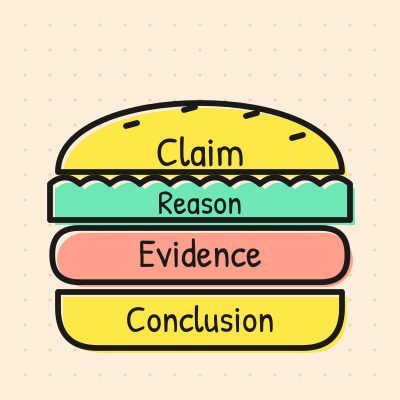
- Paragraph organization: topic sentence, evidence, analysis, link
- Thesis construction and arguable claims
- Evidence integration and commentary (the “so what?” after every quote)
- Transitions between ideas and between paragraphs
- Narrative pacing, dialogue, and sensory detail (grades 3 to 8)
- Synthesis writing across multiple sources (grades 9 to 12)
- College application essays: Common App personal statement, UC PIQs, supplemental essays
Students who build these skills through middle school enter high school English without the composition debt that compounds through every research paper, AP essay, and college application they will face.
How much does online writing tutoring cost?
Writing tutoring at Ruvimo starts at $36 per 60-minute session. No enrollment fee, and the first session is free.
- From $36 per session, 60 minutes, live 1-on-1 with a dedicated tutor. Bundles of 8+ sessions are available.
- $0 enrollment fee, no setup cost, no registration charge.
- $0 cancellation fee. Pause or stop anytime. No notice period, no penalty.
- Free first session, no credit card required, 45 minutes with a matched tutor before you commit to anything.
A typical schedule of two sessions per week is about nine sessions a month, roughly $310 to $470 depending on the package, for ongoing weekly support.
For comparison, Wyzant and Varsity Tutors both offer writing tutors, with rates varying significantly by tutor. Check each platform’s site for current pricing. In-person tutoring centers generally carry higher overhead costs reflected in their session rates. Ruvimo’s pricing covers a 60-minute live session, a dedicated tutor (the same one every time), and a written parent summary after each session.
How Ruvimo compares to other writing tutoring options
The main axes to evaluate are price per session, whether you get the same tutor every time, and session length. Most online tutoring marketplaces match students to whoever is available: you may get a different tutor each session, which matters more in writing than in math, because a writing tutor needs to track your child’s specific voice, habits, and recurring errors across drafts.
Ruvimo sessions are live, 60 minutes, 1-on-1, and always with the same tutor. There is no enrollment fee. After each session, a parent progress summary is sent by email. For families considering private tutors found through local listings, rates vary widely and typically don’t include any post-session reporting. Learning centers often require enrollment packages and may use group or semi-group formats for writing instruction. If consistent tutor relationships and written follow-up after each session matter to you, verify those specifics before signing up anywhere.
How online writing tutoring at Ruvimo works
Getting started takes less than five minutes. Here’s what happens after you book:
- Book the free session. No credit card required. Share your child’s grade, the subject, and any specific goals (a school essay, college applications, general writing skills).
- Get matched with a dedicated writing tutor before the session, based on your child’s grade and goals. We call you first, so the tutor knows your child’s level and goals before the session.
- Attend the free 45-minute 1-on-1 session. After it ends, you receive a written parent summary by email covering what was covered, what was strong, and what comes next.
Free first session. Switch tutors anytime, no charge, no questions asked.
Where writing students lose ground by grade band
Writing is the one subject where a gap almost never announces itself as a writing gap. It looks like a reading comprehension score, a history essay grade, a science lab report that gets marked down for “unclear explanation.” The actual breakdown is usually one of three things: mechanics, structure, or the failure to move from transcription to argument. Grade band determines which of those three is the most likely culprit.
Grades 3 to 5, foundations: sentence control and planned drafting
- Opinion writing with reasons and supporting evidence
- Informative and explanatory writing with facts, definitions, and linking words
- Narrative writing with sequencing, dialogue, and sensory detail
- Planning, revising, and editing as distinct steps
- Sentence-level conventions: subject-verb agreement, capitalization, comma use in dialogue; fragment and run-on identification
Where students get stuck: they treat drafting as “restarting” rather than “continuing.” The page shows the same sentence attempted three or four times: “My dog is brown. My dog he is brown and big. My brown big dog is named Max and he.” No sentence reaches its end. These students can tell you the whole story in thirty seconds but cannot transfer the narrative forward on paper because no one has taught them that planning and drafting are different activities. State assessments at this level, STAAR Grade 4 Writing, FAST (FL), CAASPP/Smarter Balanced ELA Performance Tasks, and the NY State ELA Test, require a complete, organized multi-paragraph response. A student who restarts every sentence cannot produce one. Closing this gap typically takes 4 to 6 focused sessions once the planning-vs-drafting distinction is taught explicitly.
Grades 6 to 8: argument, evidence, and what comes after the quote
- Argument writing: claim, evidence, reasoning, and counterclaim (introduced in Grade 7)
- Informative writing with cited, well-chosen evidence
- Narrative writing with pacing, transitions, and reflection
- Research: gathering information from print and digital sources, assessing credibility, avoiding plagiarism
- Misplaced and dangling modifiers; verb voice and mood including active/passive and subjunctive
Where students get stuck: they drop a quotation into a paragraph and immediately move to the next reason. “Curfews are bad for teens. ‘Teens with curfews report higher anxiety levels’ (Smith, 2019). Another reason curfews are bad is…”, the quote is there, it’s relevant, and it proves nothing without a sentence of analysis following it. The student has mistaken “I used a quote” for “I made an argument.” This failure pattern appears on STAAR Grade 7 Writing, FAST (FL), CAASPP ELA, MCAS ELA (MA), and ISEE/SSAT essays for private school applicants. Connecting this section to the prerequisite: if your child is still building foundations in grammar alongside argument structure, a tutor will work both in sequence rather than pretending grammar is already solid. Installing the claim-evidence-warrant-link sequence as automatic paragraph architecture typically takes 5 to 7 focused sessions.
Grades 9 to 12: synthesis, precision, and college application writing
The jump from high school argumentative writing to true synthesis writing catches most students off guard. A synthesis essay doesn’t ask “what do you think?”, it asks “what do multiple sources, read together, reveal that none of them says alone?” That’s a different cognitive move, and it requires practice on its own terms. At this level, sessions focus on AP English Language and AP English Literature rubrics, SAT Writing and Language section conventions, and, for seniors, the college application essay as a genre. Common App personal statements, UC PIQs, and supplemental essays each have distinct structural demands that generic essay advice doesn’t address. For students still reinforcing foundational skills at this level, high school English tutoring covers the full range from grammar to synthesis in a single program.