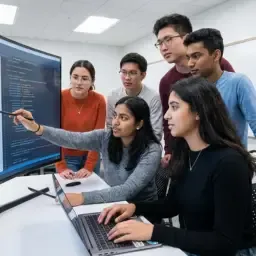
1-on-1 online tutoring
Online geometry tutors
Proofs, transformations and the reasoning behind them.
- From $36 an hour
- First session free, no card
- The same tutor every session


Reviewed by Johnrey C., Math Tutor
Geometry trips up a lot of students right around 8th grade, when abstract proofs and transformations replace the straightforward math they're used to. Ruvimo matches your child with the same tutor every session: someone who learns exactly where the confusion starts, whether that's the Pythagorean Theorem, angle relationships, or two-column proofs. Consistent sessions with a familiar face make a real difference when the concepts keep building on each other.
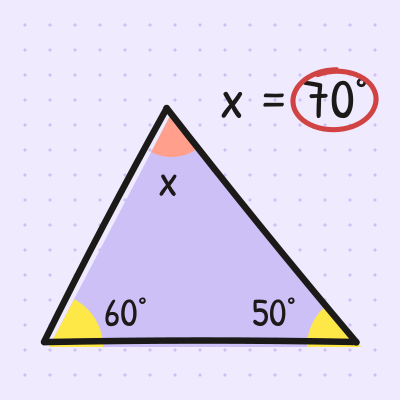
Geometry requires a completely different kind of thinking. Our tutors make the transition less painful.
Proofs. Theorems. Spatial reasoning. These don't feel like math to most students who've spent years on arithmetic and algebra. Our tutors know how to bridge that gap. How to build logical reasoning skills and connect them to the geometric content, rather than just introducing the content and hoping it sticks.
Geometry struggles come in two types: students who can't follow the logic of a proof, and students whose algebra is weak enough to break down in coordinate geometry. Those need completely different approaches. The first session tells us which we're dealing with.
A tutor who has worked with your child for a month knows which theorems they've genuinely absorbed and which ones they can recite but not apply. That's the distinction that matters in geometry. It takes time to learn, and it resets every time the tutor changes.
We work from your child's actual geometry course: the theorem sequence, the proof format, the exact conventions their teacher uses. No situation where the tutor and teacher approach the same proof differently.
The people who teach it
Tutors who teach geometry

Junior & Senior High School Math & Statistics teacher for 10+ years, making numbers make sense.
View profile

Grade 6 - 12 Mathematics Tutor. Helped 100+ students get better understanding in Mathematics.
View profile
After you book
How the free geometry session works
No card and nothing to decide first. If it is not right for your child, you owe nothing.
Pick a grade and a time
About a minute.
We call you
To hear what your child needs, so the tutor comes prepared.
Your child meets their tutor
45 minutes, live and 1-on-1.
- 17,000
- hours of 1-on-1 lessons taught
- 1,000+
- US students taught
- 200
- tutors on the team
- 90%
- parent satisfaction score
From other parents
What parents tell us
Four of them on video, unscripted, and more in their own words.
LeathaParent of a 6th grader“She was not reading fluently at all. Now she is reading 41 to 50 words a minute.”
JessicaParent of three“They all see the same tutor. He knows their names.”
A dadParent of a 7th grader“He was a straight-A student in sixth grade, then his grades were suffering. His grades have improved dramatically.”
MariaMom of three“They sign in by themselves. They look forward to these sessions.”
I like tutor Andal. She is very professional and makes my son's session very interactive. His scores improved from 80 to 85. Now we're targeting his progress to 90 plus.
Geometry student's parent
My daughter had difficulty understanding Statistics at school. Richa made it easy for her through her tutoring sessions. Thank you, Richa!
Statistics student's parent
Ramandeep connects with parents and explains her approach. She makes math very understandable for my 10th grader. My son appreciates her effort. He has improved in Math from a C to an A grade. We are now targeting that he does well with SAT prep as well.
Geometry student's parent
Pricing
Simple pricing
Your first 45-minute session is free. No credit card, no commitment. After that you buy sessions in a block and use them whenever you like.
FreeYour first 45-minute session
No credit card, no commitment.
8 sessions
$54per hour
$432 total for 8 sessions
- Valid for 3 months
- 60-minute private 1-on-1 sessions
- The same tutor every session
25 sessionsSave 17%
$45per hour
$1,125 total for 25 sessions
- Valid for 6 months
- 60-minute private 1-on-1 sessions
- The same tutor every session
- Most chosen
50 sessionsSave 33%
$36per hour
$1,800 total for 50 sessions
- Valid for 12 months
- 60-minute private 1-on-1 sessions
- The same tutor every session
- Change tutor at no charge
- Payment plans on every package
Questions parents ask
Is online geometry tutoring as effective as in-person help?
For most students, yes, and the format removes practical barriers that cause in-person tutoring to lapse. Online sessions use digital whiteboards and annotation tools that let tutors draw diagrams, highlight angles, and walk through constructions in real time. Students can annotate directly on problems, which our session observations show reduces computational errors in multi-step geometry work. Consistency matters more than format. A student who attends every weekly session online will progress faster than one who occasionally meets an in-person tutor.
How is Ruvimo different from using Khan Academy or a YouTube tutorial?
Khan Academy and video resources explain concepts but cannot respond to your child's specific mistake, ask follow-up questions, or adjust in the moment when something isn't landing. Ruvimo provides a live, 1-on-1 tutor who sees exactly where the student's reasoning breaks down, whether that's a missing step in a proof, a formula applied to the wrong shape, or a diagram misread entirely. The tutor adapts within the session, not between videos. Notes, progress summaries, and consistent pacing are also not available through self-directed platforms.
How quickly can my child improve in geometry with tutoring?
Most students show measurable progress within four to six sessions, particularly in applying formulas and working through multi-step diagram problems. Confidence with the material tends to improve before test scores do. One Grade 8 student in our sessions reached a score of 70 on a linear geometry test after consistent sessions, with the parent noting steady academic progress tied directly to the tutor matching the student's learning pace. Results depend on frequency, but weekly sessions with the same tutor produce the most consistent gains.
My child excelled in algebra but is struggling with geometry proofs, is that common?
It is common. Algebra rewards procedural fluency. Follow the steps, get the answer. Geometry proofs require a different skill: constructing a logical argument from given information to a conclusion. Students who are strong with equations sometimes find this shift disorienting. Ruvimo tutors address this by breaking proof structure into stages, identifying givens, selecting the appropriate theorem, and building the argument step by step, rather than expecting students to produce a full proof without scaffolding.
What does the parent progress summary include?
After each session, parents receive a written summary covering what was taught, how the student performed, any concepts that need reinforcement, and the practice assigned. This is sent promptly after the session ends. Not in a weekly batch. Grade 8 parents in our sessions have noted that receiving notes immediately after class, rather than days later, made a direct difference in how effectively their child practiced between sessions. The summary gives parents visibility without needing to sit in on the lesson.
What does a typical online geometry tutoring session look like?
The tutor opens by reviewing any tests, quizzes, or homework since the last session, then works through the current concept, whether that's angle proofs, circle theorems, or coordinate geometry. Sessions use digital diagrams and annotation tools, and students are encouraged to annotate problems directly rather than working through steps mentally, which our session data shows reduces errors in multi-step problems. The session ends with practice problems. Afterward, the tutor sends written notes and any assigned practice so parents and students have a clear record.
Do Ruvimo tutors follow my child's school curriculum?
Yes. Tutors align sessions to the student's current school curriculum, not a generic geometry sequence. At the start of engagement, the tutor reviews what topics are active in the student's class and structures sessions around those. The tutor plans each session from recent session notes and upcoming school material. This is why parents in our Grade 10 sessions have noted satisfaction with pacing. The tutor isn't running a separate curriculum in parallel.
Can Ruvimo support honors geometry or accelerated math tracks?
Yes. Ruvimo tutors work with students in standard, honors, and accelerated geometry courses. Honors-level work typically involves formal proofs, constructions, and more rigorous coordinate geometry. Areas where the tutor adjusts the session depth accordingly. The tutor plans each session to the student's course level, so the pacing fits whether the student is covering basic angle relationships or preparing for a proof-heavy honors exam.
Do Ruvimo tutors help with geometry homework, or only teach concepts?
Both. Tutors work through homework problems with students and teach the underlying concepts in the same session. In practice, a student might arrive with a worksheet on triangle congruence, and the tutor will use those problems to clarify the concept while completing the assignment. After the session, the tutor sends notes and the completed work so students can reference them during independent practice. A step parents in our Grade 8 sessions have directly credited for score improvement.
What happens if my child doesn't connect with their tutor?
We swap the tutor. No charge, no questions asked. A personality or teaching-style mismatch doesn't mean tutoring won't work; it just means a different tutor is a better fit. Because Ruvimo assigns the same tutor to every session by default, it's easy to tell within the first few sessions whether the pairing is working. If it isn't, families request a change and a replacement is arranged before the next scheduled session.
Are Ruvimo tutors background-checked and qualified?
Every tutor goes through AI-assisted screening followed by a manual review of credentials, teaching history, and subject knowledge before being approved. Ruvimo tutors are based in India, the Philippines, and Africa, and all hold verified academic qualifications in mathematics. Subject competency is assessed specifically. A tutor approved for geometry has demonstrated they can teach geometry, not just general math. Credentials are reviewed before a tutor ever works with a student.
How much does online geometry tutoring cost?
Ruvimo sessions start at $36 per session, which is significantly below the typical market rate of $60 to $100 per hour for private math tutoring. There are no enrollment fees. New families start with a free first session before committing to anything. Every session is 1-on-1 with the same tutor, so your child isn't re-explaining where they left off each week.
Still have a question? Ask us and a person answers, or call +1 (254) 425-4593.
Is geometry really the problem? A grade-by-grade diagnostic
High school geometry is taken in grades 9 to 11 for most students, building on the transformations and Pythagorean Theorem of middle school toward formal proofs, trigonometry, and circle theorems. The subject feels different from every math course before it, and that shift catches students off guard before they understand what changed.
Grade 8, transformational geometry foundations
- Rigid transformations: rotations, reflections, translations
- Congruence via sequences of transformations
- Dilations and similarity
- Angle relationships: parallel lines, triangle angle sum, exterior angle theorem, AA similarity
- Pythagorean Theorem: proof and coordinate applications
- Volume of cones, cylinders, and spheres
- Where students get stuck: Students can identify a rotation visually but cannot describe one precisely. Asked to “describe a sequence of transformations mapping triangle ABC to A’B’C’,” they write “it was rotated and moved” instead of “rotated 90° clockwise about the origin, then translated 3 units right.” The error is treating transformations as descriptive verbs rather than functions requiring three parameters: type, center or vector, and magnitude or direction. On a coordinate grid problem, this shows up concretely: a student rotates (3, 4) by 90° counterclockwise and writes (4, 3) instead of (−4, 3), swapping coordinates correctly but missing the sign change entirely.
- State assessments: This content appears on the CAASPP (CA), STAAR Grade 8 Math (TX), FAST PM3 (FL), NY State Grade 8 Math Test, MCAS (MA), and Smarter Balanced assessments.
- Connects to: High school geometry in 9th or 10th grade; the transformation-as-function concept is foundational to every congruence and similarity proof that follows.
- Closing this gap: Once the three-parameter rule is named explicitly with coordinate examples, most students close this gap in 3 to 5 focused sessions.
Grades 9 to 10, high school geometry
This is where the curriculum shifts most dramatically. Students who did well in algebra by following procedural steps run into a course that demands something different: justification. Every statement must be licensed by a definition, postulate, or previously proven theorem. The content is wide, covering triangle congruence (SSS, SAS, ASA, AAS, HL per CCSS HSG.CO.B.7 to 8), formal two-column and paragraph proofs, similarity and proportional reasoning, right triangle trigonometry with special right triangles, circle theorems including inscribed angles and arc length, coordinate geometry proofs using slope, distance, and midpoint, and 3D solids and cross-sections.
Where students get stuck is almost always proofs. They can state that vertical angles are congruent, but they cannot construct the argument because they do not recognize when a justification is required versus when something is given. On a test, a student writes “Statement: △ABC ≅ △DEF | Reason: They look the same,” or invokes CPCTC before establishing triangle congruence. These are not careless errors. They reflect a genuine gap in understanding what a proof is for.
- State assessments: NY Regents geometry, Florida geometry EOC, Georgia Milestones, Tennessee TNReady. Geometry content also accounts for roughly 25% of the ACT Math section and approximately 10% of SAT Math. Gaps here carry directly into Algebra 2 and beyond.
- Connects to: pre-calculus, AP Calculus, and any standardized test with a math section. Students entering 9th grade math or 10th grade math with shaky proof foundations carry that liability forward.
- Closing this gap: Building proof scaffolding to the point where a student can independently structure a 6 to 8 step proof typically takes 4 to 6 sessions. Circle theorems, once the inscribed angle pattern is named explicitly, usually click in 2 to 4 sessions.
Why students struggle with geometry (and why it’s not their fault)
Geometry doesn’t get harder. It gets more logical, and logic punishes a different kind of gap than arithmetic or algebra ever did.
Misconception 1: A proof is a description of what you see
The most common geometry failure is not a content gap. It is a structural one. Students treat proofs as explanations of what they observe rather than as chains of licensed statements. The difference is not subtle on a test. Given “Prove that the diagonals of a parallelogram bisect each other,” a student with this misconception writes: “The diagonals cross in the middle because parallelograms are symmetric, so they cut each other in half.” No congruent triangles. No SAS. No CPCTC. The reasoning sounds sensible and earns almost no credit.
Classroom instruction covers proof format but rarely addresses why the format exists. With 30 students and one pass through the chapter, most teachers move on before the underlying logic clicks. Vani, one of our geometry tutors, consistently observes this in 9th grade students: in a recent session, a student could identify every pair of congruent angles in a diagram but wrote a paragraph instead of a proof because no one had explained that the columns enforce an order of reasoning, not just a presentation style. Once that distinction was made explicit, the student restructured the same proof correctly in the same session.
Self-diagnostic signal: If your child can explain why something is true in words but loses most of the points on proof questions, this is almost certainly the active gap.
The fix: Work backward from the conclusion, identifying which postulate or theorem would justify it, then chain the statements in reverse order until the givens are reached. This “proof by reverse engineering” makes the logical structure visible before students attempt to build it forward.
Misconception 2: transformations are visual, not algebraic
Students who sail through the visual portion of transformations hit a wall the moment problems require coordinate precision. They know what a rotation looks like. They do not know that rotating a point (x, y) by 90° counterclockwise produces (−y, x), not (y, x) or (−x, −y). The sign change is not intuitive, and it is not emphasized enough in class for students to commit it reliably.
Three error forms appear regularly. First, the coordinate swap without the sign change: (3, 4) rotated 90° counterclockwise becomes (4, 3) instead of (−4, 3). Second, applying the wrong rule entirely: students use the 180° rule for a 90° rotation because both involve negatives. Third, correct rotation but wrong center: rotating about a point other than the origin without adjusting the coordinates first.
Jhuzen, one of our math tutors, noted in an 8th grade session earlier this year that encouraging students to annotate the coordinate rules directly on their diagram, rather than working mentally, eliminated most of these errors within two sessions. The student had understood the concept but had no reliable procedure to execute it under test conditions.
Self-diagnostic signal: If your child can describe a transformation correctly in words but loses points on coordinate problems, the gap is procedural, not conceptual.
The fix: Drill the four rotation rules as a reference card, then practice applying them to 5 to 6 coordinate pairs before any diagram work. Separating the algebraic rule from the geometric picture prevents the two from interfering with each other.
Misconception 3: similar figures mean “same shape, scaled evenly”
Similarity problems collapse for many students when the figures are oriented differently or when only partial information is given. Students who understand similarity as a visual concept set up proportions incorrectly because they match sides by position in the diagram rather than by their correspondence in the similarity statement. The result: they write AB/DE = BC/EF correctly, then substitute the wrong values because they read the diagram left-to-right instead of following the correspondence △ABC ~ △DEF.
This misconception shows up on every geometry EOC and on the SAT Math section. It is not a computation problem. The setup is wrong before any arithmetic begins.
Self-diagnostic signal: If your child sets up the proportion and then gets the wrong answer, and the error is in which numbers go where rather than in the cross-multiplication, this is the active gap.
The fix: Require students to label corresponding vertices explicitly on the diagram before writing any proportion. One session of enforcing this habit typically eliminates the substitution error permanently, because the visual and the symbolic are no longer in competition.
All three of these are diagnosable in a single conversation with an experienced tutor, and each closes in a handful of focused sessions, not a semester of re-teaching.