1-on-1 online tutoring
Online 5th grade math tutors
Fractions, decimals and multi-step word problems.
- From $36 an hour
- First session free, no card
- The same tutor every session


Reviewed by Wren H., Elementary & Middle School Math Specialist
5th grade math tutoring covering fractions, decimals, and multi-step word problems. Your child works with the same dedicated tutor every session, live and 1-on-1, so every skill gap is caught and closed in sequence.
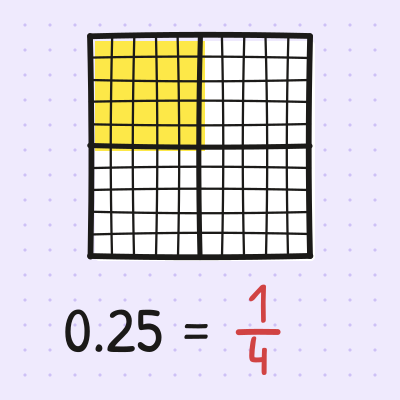
5th grade is where fraction gaps become permanent. We stop that.
Fractions, decimal multiplication, long division. Tutors on the platform work these topics daily across K-12 math. They know where the CCSS 5.NF and 5.NBT standards catch students off guard, and they come to each session with a prepared plan built around your child's specific errors, not a generic curriculum.
The first session pinpoints whether the issue is fraction reasoning, decimal place value, fact fluency, or word problem translation. Those four gaps look similar on a report card but require completely different fixes. Knowing which one is active saves weeks of re-teaching the wrong thing.
The same tutor shows every session. That matters in 5th grade because fractions, decimals, and volume connect. A tutor who was there when your child first struggled with unlike denominators knows exactly what to reference when division of fractions shows up two units later.
Sessions follow your child's actual school curriculum, whether that's Go Math, Eureka Math, or a district-specific CCSS sequence. Tutors align to the five 5th grade domains (5.OA, 5.NBT, 5.NF, 5.MD, 5.G) and sync with upcoming tests and homework, not a generic lesson plan.
The people who teach it
Tutors who teach 5th grade math

Mathematics and English Language & Arts Teacher | 10-year Teaching Services
View profile

K-5 Math Teacher | Making Math Simple & Engaging | Fractions & Concept-Based Learning
View profile

Math & English Tutor | Building Academic Confidence and the Life Skills Beyond the Textbooks
View profile

Online Educator since 2019. I teach Math, English and History. Registered Nurse by profession.
View profile

Passionate Math & Physics Tutor | Pre-Algebra to Calculus and Classical Mechanics to Modern Physics.
View profile

Making Math Fun, Building Confident Learners from all Grade Levels!
View profile
After you book
How the free 5th grade math session works
No card and nothing to decide first. If it is not right for your child, you owe nothing.
Pick a grade and a time
About a minute.
We call you
To hear what your child needs, so the tutor comes prepared.
Your child meets their tutor
45 minutes, live and 1-on-1.
- 27,900+
- hours of 1-on-1 lessons taught
- 1,150+
- US students taught
- 200
- tutors on the team
- 90%
- parent satisfaction score
From other parents
What parents tell us
Four of them on video, unscripted, and more in their own words.
LeathaParent of a 6th grader“She was not reading fluently at all. Now she is reading 41 to 50 words a minute.”
JessicaParent of three“They all see the same tutor. He knows their names.”
Dad of a 7th grader “He was a straight-A student in sixth grade, then his grades were suffering. His grades have improved dramatically.”
MariaMom of three“They sign in by themselves. They look forward to these sessions.”
Tutor is good and teaches wonderfully to Eliana. She copes well with Eliana's progress and gives me feedback regarding Eliana on a daily basis.
5th grade math student's parent
What works really well for me is knowing that my child has a tutor that's invested in helping him become stronger in math that he once feared and would break down and cry. He is now tackling it head on, showing more confidence and taking the work more seriously.
5th grade math student's parent
One-on-one really helps well. She is learning and enjoying the sessions with Ram. She looks forward to every Monday and Thursday. The tutor's teaching and clarity. I would like to give 10 stars for this!
5th grade math student's parent
Pricing
Simple pricing
Your first 45-minute session is free. No credit card, no commitment. After that you buy sessions in a block and use them whenever you like.
FreeYour first 45-minute session
No credit card, no commitment.
8 sessions
$54per hour
$432 total for 8 sessions
- Valid for 3 months
- 60-minute private 1-on-1 sessions
- The same tutor every session
25 sessionsSave 17%
$45per hour
$1,125 total for 25 sessions
- Valid for 6 months
- 60-minute private 1-on-1 sessions
- The same tutor every session
- Most chosen
50 sessionsSave 33%
$36per hour
$1,800 total for 50 sessions
- Valid for 12 months
- 60-minute private 1-on-1 sessions
- The same tutor every session
- Change tutor at no charge
- Payment plans on every package
Questions parents ask
Does Ruvimo only offer math tutoring?
No. Ruvimo offers live 1-on-1 tutoring across multiple subjects for grades K-12, including English (reading and writing), science, Spanish, History, coding, Guitar, Singing, and Chess, in addition to math. Every subject follows the same format: same tutor every session, AI-assisted lesson plans before each session, and a written parent summary after.
Can a tutor help if my child is behind from a previous grade?
Yes, and catching prior-grade gaps is often the first priority. Most 5th grade fraction struggles trace back to equivalent fractions and benchmark fractions from 3rd and 4th grade. Most decimal errors trace back to place value concepts introduced in 4th grade. A tutor identifies exactly where the gap starts, whether that's in the current grade or one below, and fills it in sequence rather than re-teaching everything from scratch.
What's the difference between a 5th grade math tutor and a math app like Khan Academy?
A math app can explain concepts and provide practice problems. What it can't do is notice that your child gets the common denominator right and then adds the denominators anyway, and stop to address exactly that error in real time. A live tutor asks the student to explain their answer, catches the specific misconception, and adjusts the next problem accordingly. Apps are useful for reinforcement between sessions. They don't replace the diagnostic conversation.
Is 5th grade math tested by the state?
Yes. Grade 5 is a state-tested year in most states. Fraction and decimal problems appear on the CAASPP/SBAC Grade 5 test (California), STAAR Grade 5 Mathematics (Texas), Florida's FAST assessment, and the NY State Grade 5 Math Test, among others. Multi-digit multiplication and division are also tested on all four. Tutoring sessions can be aligned to an upcoming state test if that's the immediate priority.
How many tutoring sessions does a 5th grader typically need?
It depends on the gap. The "add across" fraction misconception typically resolves in 3 to 4 focused sessions once the denominator's meaning is addressed directly. Decimal place-value reasoning usually takes 2 to 3 sessions. Multiplication fact fluency is an ongoing drilling task. Measurable gains typically appear within 4 to 6 weeks of daily practice alongside sessions. A single isolated topic can often be closed in under a month; multiple gaps spread across domains take longer.
How does online math tutoring work for a 5th grader?
At Ruvimo, every session is live and 1-on-1. Before the first session, AI identifies where the gaps are so the tutor arrives with a focused plan. Sessions run 60 minutes via video. After each session, parents get a written summary covering what was worked on, what clicked, and what comes next. Your child works with the same tutor every session, not a rotating pool.
How do I know if my child needs a 5th grade math tutor?
The clearest signals: homework takes far longer than it should, test scores drop on any section asking students to explain their reasoning, fraction answers look like whole-number addition (1/2 + 1/3 = 2/5), decimal point placement is inconsistent, or word problems cause a full stop even when the underlying computation is fine. Any one of these points to a specific gap, not a general math problem.
Why is 5th grade math so hard for some kids?
5th grade is the year math stops being mostly procedural and starts requiring number reasoning. Three shifts trip students up most: (1) fractions with unlike denominators, where the "add across" shortcut that worked for whole numbers produces wrong answers; (2) decimal operations, where "line up the decimal point" no longer works for multiplication; and (3) multi-step word problems, where translating a real-world scenario into operations is a separate skill from doing the calculation itself.
What math topics are covered in 5th grade?
Fifth grade math follows five CCSS domains: Operations & Algebraic Thinking (5.OA), Number & Operations in Base Ten (5.NBT), Number & Operations: fractions (5.NF), Measurement & Data (5.MD), and geometry (5.G). The big shifts are fractions with unlike denominators, decimal multiplication and division, multi-digit long division, volume using the formula V = l×w×h, and graphing ordered pairs on a coordinate plane.
Is Ruvimo cheaper than Mathnasium or Sylvan Learning?
Ruvimo's rate is from $36 per hour with no enrollment fee. Mathnasium and Sylvan Learning both charge more per hour and require enrollment or monthly membership commitments. For current pricing at those centers, check mathnasium.com and sylvanlearning.com directly. If you want a full breakdown of the trade-offs, this comparison of Mathnasium vs. alternatives covers what each format does well, and where each falls short.
How much does online 5th grade math tutoring cost?
At Ruvimo, 5th grade math tutoring starts at $36 per hour. There's no enrollment fee, and the first session is free, 45 minutes. No credit card required. Bundles of 8 or more sessions are available. Two sessions per week is about nine sessions a month, roughly $310 to $470 depending on the package.
How can I help my 5th grader with math at home?
The most effective thing parents can do is target the specific gap: not just "do more math." If fractions are the issue, work on what a denominator actually means (the size of the piece, not a number to add). If fact fluency is slow, 5 minutes of daily multiplication drilling makes a measurable difference within a few weeks. A tutor can tell you exactly which gap to focus on after the first session.
Still have a question? Ask us and a person answers, or call +1 (254) 425-4593.
Fifth grade math covers the five domains of the Common Core curriculum: fractions with unlike denominators, decimal operations, multi-digit multiplication and division, volume, and coordinate geometry. Students who master these skills enter middle school ready for ratios, proportional reasoning, and pre-algebra. A tutor identifies exactly which domain is breaking down, then works through it concept by concept, not procedure by procedure.
Signs your child needs a 5th grade math tutor
Most 5th grade math struggles show up at the fraction wall, the decimal shift, or both, and each requires a different fix.
- Adds 1/2 + 1/3 and writes 2/5 on a graded test
- Gets the digits right on decimal multiplication but puts the decimal point in the wrong place
- Freezes on word problems that were fine when they were just computation drills
- Homework takes three times as long as it should because multiplication fact recall is slow
- Can find the area of a rectangle but cannot explain what volume means or how to set it up
- Score drops sharply on any test section marked “explain your reasoning”
What a 5th grade math tutor helps with
A 5th grade math tutor works across five skill clusters: fractions, decimal operations, multiplication and division fluency, measurement and volume, and coordinate geometry.
- Adding and subtracting fractions with unlike denominators
- Multiplying and dividing fractions and mixed numbers
- Interpreting a fraction as division
- Decimal place value to thousandths and rounding
- Multiplying and dividing decimals to hundredths
- Multi-digit multiplication and long division
- Volume using unit cubes and V = l×w×h
- Coordinate plane, first quadrant
- Numerical expressions with parentheses and brackets
Students who close these gaps before the end of 5th grade enter 6th grade math ready for ratios and proportional reasoning, rather than carrying fraction debt into every subsequent unit.
How much does online 5th grade math tutoring cost?
5th grade math tutoring at Ruvimo starts at $36 per hour. No enrollment fee, and the first session is free.
- From $36 per session (60 minutes): bundles of 8+ sessions are available
- $0 enrollment fee: no setup costs, no registration charges
- $0 cancellation fee: pause or stop anytime, no penalty
- Free first session: a 45-minute session, no credit card required
A typical schedule of two sessions per week is about nine sessions a month, roughly $310 to $470 depending on the package, for ongoing weekly support.
For comparison, in-person learning centers generally charge more per hour and require enrollment contracts. Check Sylvan Learning’s and Mathnasium’s sites for their current pricing. If you’re weighing your options, this breakdown of whether Mathnasium is worth the cost covers the key trade-offs.
How Ruvimo compares to other 5th grade math tutoring options
The three main choices parents consider are in-person learning centers, online tutoring marketplaces, and dedicated online tutoring services. They differ on price and session consistency.
| Option | Format | Price | Same tutor every session |
|---|---|---|---|
| Ruvimo | Live 1-on-1, online | from $36/hr | Yes |
| Sylvan Learning | In-person or online, small group | Check sylvanlearning.com | Varies |
| Mathnasium | In-person center, group setting | Check mathnasium.com | No, rotating instructors |
| Online marketplace tutors | Live 1-on-1, online | Varies widely by tutor | Only if you re-book same tutor |
How online 5th grade math tutoring at Ruvimo works
Every session is live and 1-on-1, and with the same tutor. Before your child’s first session, AI maps out where the gaps are so the tutor arrives prepared, not guessing.
- Book the free session. No credit card required. Takes about a minute.
- Get matched with a dedicated tutor before the session, based on your child’s grade, specific topics, and learning pace.
- Attend the free 45-minute 1-on-1 session, followed by a written parent summary sent to you by email: what was covered, what clicked, and what comes next.
Free first session. Switch tutors anytime, no charge, no questions asked.
Where 5th grade math students lose ground
Fifth grade is the year fractions stop being simple. For the three previous years, students worked with fractions that share denominators or use benchmark numbers like 1/2. In 5th grade, CCSS 5.NF.A.1 requires adding and subtracting fractions with any unlike denominators, and that shift exposes every conceptual shortcut students got away with in 3rd and 4th grade.
If your child is still building foundations in 4th grade math, equivalent fractions, basic decimal notation, multi-digit multiplication, those gaps need attention before 5th grade fraction work will stick. These are the three places that show up most clearly on assessments.
Fractions with unlike denominators
- Finding common denominators and converting fractions before adding or subtracting
- Estimating whether an answer is reasonable (e.g., 1/2 + 1/3 must be less than 1)
- Applying unlike-denominator addition to word problems
- Where students get stuck: a student finds the common denominator correctly, then adds the denominators anyway. Writing 1/2 + 1/3 = 2/6 instead of 5/6. They completed one step of the procedure and then reverted to the whole-number “add everything” reflex.
- State assessments: unlike-denominator fraction problems appear on the CAASPP/SBAC Grade 5 test, STAAR Grade 5 Mathematics, and Florida’s FAST assessment. Grade 5 is a state-tested year in Texas and Florida.
- Connects to: ratio and proportional reasoning in 6th grade; fraction fluency is the foundation.
- Closing this gap: with visual fraction models and targeted practice, the “add across” error typically resolves in 3 to 4 focused sessions once the denominator’s meaning is addressed directly.
Decimal operations
This is where place value either solidifies or falls apart. Students who memorized decimal rules in 4th grade (“line up the decimal point”) arrive in 5th grade needing to multiply and divide decimals. Operations where lining up the point is no longer the procedure. A student who understands that 0.4 means 4 tenths can reason that 0.4 × 0.3 must produce hundredths. A student who only knows “put the decimal somewhere” writes 1.2 and moves on. On the NWEA MAP Growth and i-Ready Diagnostic, this error pattern shows up as a place-value gap, not an operations gap, but it only becomes visible when a tutor asks the student to explain what their answer means, not just how they got it. Closing the place-value reasoning gap typically takes 2 to 3 sessions once it’s reframed away from rules.
Multiplication fact fluency and multi-digit division
- Standard algorithm for multi-digit multiplication
- Four-digit dividend ÷ two-digit divisor, with remainders
- Where students get stuck: slow fact recall turns every multi-step problem into an endurance event. A student who knows the concept of long division but pauses 8 to 10 seconds per basic fact runs out of working memory before they finish the problem, and accumulates errors that look like conceptual gaps but are actually fluency gaps.
- State assessments: multi-digit multiplication and division are tested on CAASPP, STAAR, FAST, and the NY State Grade 5 Math Test.
- Connects to: fraction division and decimal operations in the same grade; slow facts bottleneck every domain simultaneously.
- Closing this gap: fact automaticity is an ongoing drilling task, but measurable fluency gains are typical within 4 to 6 weeks of daily practice alongside sessions.
Why students struggle with 5th grade math (and why it’s not their fault)
Fifth grade math doesn’t just get harder. It requires students to reason about numbers, not just operate on them. That shift catches a lot of capable kids off guard.
The “add across” fraction misconception
Students who write 1/2 + 1/3 = 2/5 are not being careless. They are applying the model that worked for four years of whole-number addition: when you add, you combine both numbers. Nobody told them that the denominator names the size of the piece, not a quantity to be combined. So the procedure feels correct. Research by Siegler et al. (2011) on early predictors of math achievement identifies fraction understanding as the single strongest predictor of later math success, which means this error compounds far beyond 5th grade if it isn’t caught.
If your child