1-on-1 online tutoring
Online algebra tutors
Equations, graphs and functions, from 6th grade to Algebra 2.
- From $36 an hour
- First session free, no card
- The same tutor every session


Reviewed by Musab K., Math Tutor & Data Analytics Specialist
Algebra builds on itself. A shaky foundation in 6th grade shows up as a failing grade in 9th. Your child works with the same tutor every session, so gaps get caught early and fixed before they compound. Live, 1-on-1 instruction means your tutor adapts in real time to exactly where your child is stuck.
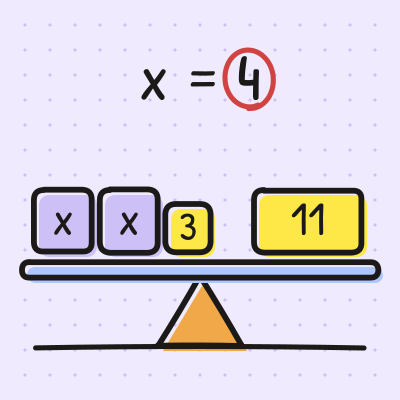
Algebra is the gateway to every math course after it. Get it right the first time.
Our tutors have worked with algebra students at every level: first-timers, students repeating the course, students who got through it but never really understood it. They know how to find where comprehension breaks down and how to rebuild from there.
Most algebra confusion starts in one of three places: fractions, negative numbers, or order of operations. These aren't algebra problems. They're arithmetic gaps that make algebra impossible. The first session finds which one applies and fixes it before anything else.
No rotation. One tutor knows which problem types your child has genuinely mastered and which ones are still iffy. Sessions build on that knowledge instead of re-testing it every time.
We follow your child's actual algebra course: the textbook, the methods, the problem formats. What the tutor practices with your child is as close as possible to what shows up on tests.
The people who teach it
Tutors who teach algebra

Junior & Senior High School Math & Statistics teacher for 10+ years, making numbers make sense.
View profile

IB MYP and DP, IGCSE, US Common Core Mathematics Teacher
View profile

Grade 6 - 12 Mathematics Tutor. Helped 100+ students get better understanding in Mathematics.
View profile
After you book
How the free algebra session works
No card and nothing to decide first. If it is not right for your child, you owe nothing.
Pick a grade and a time
About a minute.
We call you
To hear what your child needs, so the tutor comes prepared.
Your child meets their tutor
45 minutes, live and 1-on-1.
- 27,900+
- hours of 1-on-1 lessons taught
- 1,150+
- US students taught
- 200
- tutors on the team
- 90%
- parent satisfaction score
From other parents
What parents tell us
Four of them on video, unscripted, and more in their own words.
LeathaParent of a 6th grader“She was not reading fluently at all. Now she is reading 41 to 50 words a minute.”
JessicaParent of three“They all see the same tutor. He knows their names.”
Dad of a 7th grader “He was a straight-A student in sixth grade, then his grades were suffering. His grades have improved dramatically.”
MariaMom of three“They sign in by themselves. They look forward to these sessions.”
Christi has been great helping Sterling navigate through his understanding with algebra. I can see that he is getting more comfortable with math as a whole and the various components of the topics.
Algebra student's parent
My daughter had difficulty understanding Statistics at school. Richa made it easy for her through her tutoring sessions. Thank you, Richa!
Statistics student's parent
I like tutor Andal. She is very professional and makes my son's session very interactive. His scores improved from 80 to 85. Now we're targeting his progress to 90 plus.
Geometry student's parent
Pricing
Simple pricing
Your first 45-minute session is free. No credit card, no commitment. After that you buy sessions in a block and use them whenever you like.
FreeYour first 45-minute session
No credit card, no commitment.
8 sessions
$54per hour
$432 total for 8 sessions
- Valid for 3 months
- 60-minute private 1-on-1 sessions
- The same tutor every session
25 sessionsSave 17%
$45per hour
$1,125 total for 25 sessions
- Valid for 6 months
- 60-minute private 1-on-1 sessions
- The same tutor every session
- Most chosen
50 sessionsSave 33%
$36per hour
$1,800 total for 50 sessions
- Valid for 12 months
- 60-minute private 1-on-1 sessions
- The same tutor every session
- Change tutor at no charge
- Payment plans on every package
Questions parents ask
What's the difference between pre-algebra and Algebra 1, and where does my child start?
pre-algebra is where students first encounter variables and move beyond pure arithmetic. Algebra 1 builds on that foundation with linear equations, inequalities, and systematic problem-solving. Skipping or rushing pre-algebra creates gaps that compound quickly. Grade 7 students frequently hit a wall with multiplication and division of larger numbers precisely because that computational fluency was never solidified. The tutor assesses your child in the first session and places them at the point where their foundation is actually solid, not where the grade level assumes they should be.
How do I know if my child needs an algebra tutor?
Watch for avoided homework, frustration that spikes around test time, or grades that don't match how much effort your child puts in. In our sessions, we frequently see students, especially in grades 6 to 8, who understand the material conceptually but lose confidence the moment a timed worksheet or classroom setting adds pressure. One parent described their child as speaking well with known people but fumbling in school: that confidence gap is as real an obstacle as a content gap, and it responds directly to consistent 1-on-1 work.
Will my child's algebra tutor know their school's curriculum?
Yes. Ruvimo tutors know the Common Core standards and the programs US districts use, such as CPM, Illustrative Mathematics and Big Ideas Math. Whatever your child's school uses, the tutor aligns session content with what's currently being taught in class, so homework, tests, and in-class expectations are all in scope, not a separate track.
What does a parent progress report include?
After each session, parents receive a written summary covering what was taught, which problems the student worked through, where errors appeared, and what to review or practice before the next session. For Grade 8 to 10 families especially, this report functions as a home-review guide.
Is online algebra tutoring as effective as in-person?
For most students in grades 8 to 10, yes. The consistent-tutor model matters more than the format: students who work with the same person each session build the kind of trust that reduces the anxiety we frequently see in this age group. In our sessions, students who hesitate to speak up in class often engage much more openly in a 1-on-1 online setting, which directly affects how quickly they work through algebraic concepts.
How is Ruvimo different from Khan Academy or a tutoring app?
Khan Academy delivers content at a fixed pace with no awareness of your child's specific gaps. Ruvimo pairs your child with the same tutor every session: someone who prepares for each class, adjusts in real time when a concept isn't landing, and notices when frustration is blocking progress on material the student actually understands. That combination of continuity and live responsiveness is what self-paced platforms can't replicate.
How quickly will my child see improvement in algebra?
Every child moves at their own pace, so we do not promise a number of sessions. You get a note after every session on what was covered and what to practice, so you can see progress as it happens rather than wait for a report card.
Can you support honors algebra or accelerated math tracks?
Yes. Tutors work with students in honors, accelerated, and gifted programs across grades 8 to 10. For advanced students, the tutor builds on confirmed strengths and introduces upcoming topics with proper scaffolding rather than rushing ahead.
Do your tutors help with homework, or only teach concepts?
Both, and the combination is deliberate. Tutors use homework problems as the entry point for identifying gaps, then teach the underlying concept directly. One Grade 8 parent noted that the notes and homework assigned between sessions made a measurable difference in practice performance. After each session, parents receive a progress summary covering what was covered, what gaps remain, and what to review at home.
What if my child doesn't connect with their algebra tutor?
We swap tutors. No charge, no questions asked. Your child works with the same tutor each session by default, so you'll know quickly whether the fit is working. If it isn't, the replacement process is straightforward and doesn't reset your child's progress. Session notes and identified gaps transfer so the new tutor starts informed, not from scratch.
Are Ruvimo's algebra tutors background-checked and vetted?
Every tutor goes through AI-assisted screening followed by a manual review of credentials, teaching history, and subject-matter depth before their first session. Tutors are based across India, the Philippines, and Africa, and all hold at least a bachelor's degree in mathematics or a related field. Subject knowledge is verified specifically for the grade range they teach, not just assumed from a degree.
How much does online algebra tutoring cost?
Sessions start at $36 each. Well below the $60 to $100 per hour typical of local in-person tutors or premium platforms. There are no enrollment fees. Your child's first session is free so you can evaluate the tutor fit and teaching style before spending anything.
Still have a question? Ask us and a person answers, or call +1 (254) 425-4593.
Is algebra really the problem? Understanding the grade 6 to 10 progression
Algebra spans five years of Common Core standards, from writing a first variable expression in 6th grade to factoring quadratics in Algebra 2. A student struggling in 9th grade is almost never struggling with 9th-grade material alone. The gap usually started earlier, and knowing exactly where it started is what makes targeted tutoring faster than repeating the whole course.
Grades 6 to 7, pre-algebra foundations
- Ratios, proportional relationships, and unit rates
- Writing and evaluating algebraic expressions; identifying equivalent expressions
- Solving one- and two-step equations and inequalities
- Operations with all rational numbers, including signed arithmetic
- Where students get stuck: Students who learned “two negatives make a positive” as a phrase can handle −5 + 3 = −2 correctly but write −5 − (−3) = −8 because they cannot decide whether the rule applies to the subtraction sign, the negative on the 3, or both. They guess. Every multi-step equation that follows inherits that error. A related trap: students who learned “a variable is a letter” can substitute and evaluate 3x when x = 4, but asked to write an expression for “7 less than twice a number,” they write 7 − 2n instead of 2n − 7 because they translate left-to-right like a sentence.
- State assessments: These concepts appear on 6th- and 7th-grade CAASPP, STAAR, FAST, and Smarter Balanced benchmarks.
- Connects to: All of Algebra 1. If your child is still building foundations here, see our pre-algebra tutors page before moving into Algebra 1 work.
- Closing this gap: Signed-number fluency, once rebuilt from the number line up, typically takes 4 to 6 focused sessions. Translation reversal closes faster, usually 3 to 4 sessions once the error is named explicitly.
Grades 8 to 9, Algebra 1
This is where the curriculum sharpens fastest. Students who sailed through arithmetic hit a wall when the equals sign stops meaning “here comes the answer” and starts meaning “these two sides balance.” The most telling failure point is variables-on-both-sides equations. A student who can solve 3x + 5 = 20 by undoing each operation will often write 3x + 5 = x + 13 as 3x − x + 5 = 13, then jump to 2x = 8 without ever moving the 5. The 5 crosses the equals sign without changing sign because the student is following a procedure, not a model. Linear equations, systems of equations, slope and y = mx + b, and the introduction of functions all live here. For 8th grade math students, this material also feeds directly into CAASPP Grade 8, STAAR Grade 8 and Algebra 1 EOC, the Florida Algebra 1 EOC, and the NY Regents Algebra 1 exam. Closing the equals-sign model gap takes 4 to 6 sessions once it is taught explicitly as balance rather than command. Students who also need to solidify literal-equation manipulation, rearranging 2x − 4y = 8 into slope-intercept form, for example, should expect another 2 to 3 sessions on top of that before both skills are reliable under test conditions.
Grades 9 to 10, Algebra 2 onramp
- Creating and solving equations in one and two variables
- Justifying algebraic steps; solving linear equations and inequalities
- Systems of equations solved algebraically and graphically
- Factoring quadratics, completing the square, quadratic formula
- Where students get stuck: Factoring is the single most error-prone topic at this level. Students who factor by trial and error rather than structure drop the negative on the middle term consistently. They write (x + 5)(x − 2) when the answer is (x − 5)(x + 2) because they found two numbers that multiply to −10 but didn’t track which one carries the sign. The error is invisible until they check by expanding, and most don’t check. Beyond factoring, signed-number errors resurface at this level too. Even students performing well in Algebra 1 can lose track of negative coefficients inside multi-step polynomial problems, which suggests the concept needs more sustained attention than most curricula provide before moving into complex algebraic manipulation.
- State assessments: Algebra 2 content appears on the PSAT, SAT Math, and ACT, as well as state Algebra 1 and Algebra 2 end-of-course exams. Students who advance to Algebra 2 carry every factoring gap directly into rational expressions and polynomial division.
- Closing this gap: Structured factoring, the AC method or factor by grouping, replaces trial-and-error reliably in 3 to 5 sessions for most students. Addressing the full grade band, including systems, equation justification, and quadratics, typically requires 8 to 12 focused sessions depending on how many prerequisite gaps are present.
Why students struggle with algebra (and why it’s not their fault)
Algebra doesn’t get harder. It gets more precise, and precision punishes gaps. Three specific misconceptions account for the majority of the errors tutors see across grades 6 to 10. Each one is diagnosable. None of them requires starting over.
The variable misconception: “x is just a letter”
Students in grades 6 to 7 are typically taught that “a variable stands for an unknown number.” That definition is functional for simple substitution. It breaks down the moment a variable represents a relationship rather than a single value. Students who hold the “letter” model can evaluate 3x for a given x but cannot write an expression from a verbal description without reversing it. “5 less than a number” becomes 5 − n because that’s the order the words appear. A 1981 study by Clement, Lochhead, and Monk documented exactly this error, students translating “there are six times as many students as professors” as 6S = P instead of 6P = S, and it still shows up in algebra sessions today at the same rate.
Abhishek, one of our algebra tutors, works primarily with grade 6 students and builds casual conversation into early sessions intentionally because students who get bored or anxious stop attempting problems entirely. In a recent session, a student who could evaluate expressions without hesitation drew a blank on a write-the-expression prompt. Abhishek had the student narrate the problem in their own words before writing anything, and the correct expression followed immediately. The student didn’t have an algebra gap. They had a translation habit.
If your child can evaluate an expression when you give them a value for x but cannot write one from a word problem, this is almost certainly the active gap. The fix is to practice verbal-to-symbolic translation as its own skill, separately from equation solving. Not more problems, different problems.
The signed-number gap: A rule without a model
This is the most common hidden gap in grades 7 to 8, and it is almost never caught before Algebra 1. Students learn “minus a negative is a plus” as a chant. They apply it correctly when there are exactly two negatives adjacent to each other and nothing else is happening. Add a third term, −4 − (−6) − 3, and the rule stops working. One student writes −4 + 6 + 3 = 5, absorbing the −3 into the sign rule because the rule says “the negatives cancel.” Another writes −4 + 6 − 3 = −1 by accident, which is actually correct, but for the wrong reason, so the next problem goes wrong again.
Jhuzen, one of our 7th grade math tutors, noted in a session review that a student had grasped the basics of algebra including simplifying expressions and solving basic equations, but needed regular practice to keep signed-number operations reliable under pressure. The pattern is consistent: students understand the concept in isolation and lose it inside a multi-step problem. That is not a memory problem. It is a model problem. The intervention is the number line. Physically, not abstractly. Students who plot −4 − (−6) on a number line before writing the answer stop making this error within a session or two.
If your child computes isolated signed-number problems correctly but loses track of signs inside a two- or three-step equation, this is the active gap. Rebuilding from the number line typically takes 4 to 6 sessions before the fluency becomes automatic.
The equals sign as command, not balance
Research in math education has documented for decades that many students enter algebra treating the equals sign as “now write the answer” rather than “these two sides are equal.” The practical consequence appears on variables-on-both-sides equations. Students who solve x + 7 = 12 by inspection, without a model, freeze on 3x + 5 = x + 13. Three distinct errors appear at this point. Some students subtract 3x from both sides and end up with 5 = −2x + 13, then panic at the negative coefficient and abandon the problem. Others move the 5 across the equals sign without changing its sign, writing 3x = x + 13 + 5. A third group subtracts correctly on the left but forgets to subtract on the right. All three errors have the same root: no mental model of the equation as a balanced scale.
Reviewing the session notes together at home between sessions helps here. What changes is not the amount of algebra instruction but the student developing the habit of asking “does this still balance?” before committing each step to paper.
If your child solves single-operation equations in their head but falls apart when variables appear on both sides, this is the gap to address first. The fix is to work the same problem using a balance scale model before introducing symbolic manipulation. Concrete to abstract, not abstract from the start.
All three of these gaps are diagnosable in a single focused session. Once identified, each one typically closes in far fewer sessions than parents expect, not because the student suddenly got smarter, but because a foundational concept that was never made explicit finally gets named, modeled, and practiced in sequence. That is exactly what 1-on-1 online math tutoring is structured to do.