Ruvimo is one of the programs compared in this guide.
The Reality of the 2026 Learning Gap
We aren’t just dealing with missed lessons anymore. Today’s U.S. students are navigating a post-pandemic, AI-integrated curriculum where the speed of instruction often outpaces individual comprehension. If a student misses the conceptual leap from arithmetic to proportional reasoning in 6th grade, they don’t just get a lower grade - they lose the foundation for Algebra.
Closing math gaps requires more than just more practice. It requires individualized instruction that identifies exactly where the logic broke down.
1. Kumon: The “Stamina” Approach
Let’s start with the veteran in the room. If you’ve lived in a U.S. suburb for more than five minutes, you’ve seen the Kumon signs. Their philosophy is simple: practice makes perfect.
How it actually feels for a student:
When your child walks into a center, they aren’t meeting with a math teacher in the traditional sense. They are handed a packet. The instructor is there to grade the work and ensure they follow the method.
- The “Start Low” Strategy: One thing that surprises parents is that Kumon often starts kids below their current grade level. If your child is struggling with 4th-grade decimals, Kumon might put them on 2nd-grade addition to build confidence.
- The Daily Grind: It’s a 7-day-a-week commitment. Those 15-20 minutes of daily worksheets are non-negotiable.
Is it right for closing gaps?
Here’s the catch: Kumon is phenomenal for fluency. If your child is slow at calculations, it works. But if they don’t understand why they are doing a process, Kumon’s repetitive nature can actually mask learning gaps in math. They learn the trick to get the answer, but they might still struggle when a word problem on a state test asks them to apply that logic in a new way.
2. Superprof: The Wild West of Tutoring
If you go to Google and search for math tutor, Superprof is almost certainly going to be the first result. It is the Amazon of education. You can find anyone from a 19-year-old engineering student to a retired high school math teacher with 30 years of experience.
The Marketplace Experience:
The beauty of Superprof is the price point and the variety. If you specifically need an online math tutor for elementary students US, you can filter by price, location, and reviews.
- One on One Tutoring: Unlike the group setting of some centers, this is pure individual attention.
- The Vetting Burden: This is where it gets tricky for parents. You are the hiring manager. You have to read the Kumon vs Superprof reviews for struggling students and decide if that tutor actually knows how to handle a child with a learning disability or if they’re just good at math themselves.
The Verdict on Superprof:
It’s a great tool if you are on a budget and have the time to interview multiple people. However, for tutoring for kids who are significantly behind, the lack of a standardized curriculum or oversight can lead to “band-aid tutoring” - helping with tonight’s homework without ever fixing the root cause of the gap.
3. Ruvimo: The Specialist’s Solution
In the last year, Ruvimo has become the go-to recommendation in parent Facebook groups and school districts. Why? Because they’ve realized that 2026 students don’t need more content - they need a mentor who understands the specific hurdles of the American school system.
Why Ruvimo feels different:
While Kumon is about the system and Superprof is about the person, Ruvimo is about the results.
- Direct Curriculum Alignment: Most online math tutoring services use their own special curriculum. Ruvimo does something radical: they use your child’s actual school textbook. If the teacher is teaching CPM Math or Eureka Math at school on Monday, the Ruvimo mentor is reinforcing that exact same logic on Tuesday night.
- The “Live” Edge: This isn’t a series of recorded videos or AI-generated quizzes. It is one on one tutoring with a human being on a high-tech digital whiteboard. The tutor sees the “hesitation” in the student’s digital pen and intervenes immediately.
- Targeted for The Wall: Every student hits The Wall at some point - usually in Algebra1 or Geometry. Ruvimo’s tutors are specifically trained in closing math gaps by identifying the specific grade-level concepts that are missing.
Best math program for kids with learning disabilities?
For parents of students with dyscalculia or ADHD, Ruvimo is often the only viable choice of the three. Why? Because individualized instruction for a neurodivergent student requires empathy and real-time adjustment. You can’t get that from a Kumon worksheet, and you can’t always guarantee it from a random marketplace find.
Summary of the “Big Three” Comparison
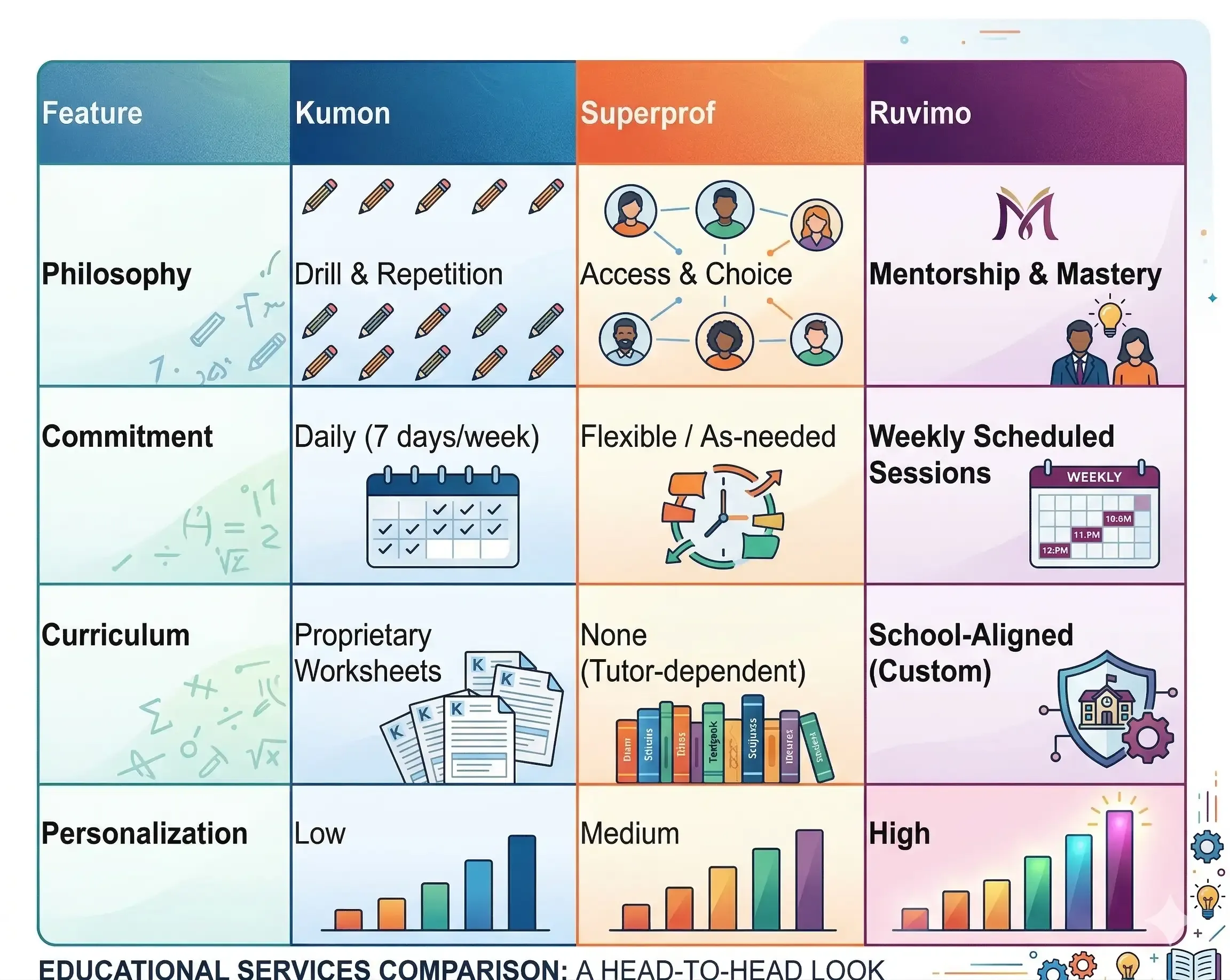
Big Three Comparison
The 2026 Math Pivot - Curriculum Crises and the High-Stakes Prep
By the time your child reaches middle or high school in 2026, the stakes of learning gaps in math change. It’s no longer just about finishing a worksheet; it’s about state testing, the newly digital SAT/ACT, and the aggressive pace of AP courses.
When parents search for a math tutor, they often have a specific “fire” they are trying to put out - a failed Algebra test or a confusing Geometry project. But to actually close the gap, the solution has to match the specific way math is being tested today.
The Common Core Evolution and the 2026 Classroom
In 2026, the U.S. education system has doubled down on conceptual mastery. It isn’t enough to know that $2 + 2 = 4$; students have to explain why it equals four using a number line, a grid, and a written paragraph. This is where programs like Kumon often hit a wall.
Because Kumon is built on older, procedural models, a student might be a “Level L” in Kumon (doing advanced Calculus drills) but still struggle with a 7th-grade Common Core word problem that requires deep logical reasoning.
Why Ruvimo’s Textbook Sync Matters
This is where Ruvimo has found its edge. They realized that a math teacher in a U.S. public school is grading based on specific state standards. If your child is using a Ruvimo mentor, that mentor is looking at the actual PDF of your child’s school textbook.
- The Friday Test Prep: If the class is doing Integrated Math II, the tutor isn’t teaching General Geometry. They are teaching exactly what is on the study guide for Friday.
- Closing the Context Gap: Unlike the “Wild West” of Superprof, where a tutor might be from a different country and use different terminology, Ruvimo focuses on U.S.-based standards. They know what “SOH-CAH-TOA” is, and they know why your child’s teacher is obsessed with number bonds.
The 2026 Testing Shift: SAT and ACT Changes
The biggest stress bomb for 2026 parents is the college entrance exam. Both the SAT and ACT have gone through radical changes. The SAT is now fully digital and adaptive - the test literally gets harder or easier while your child is taking it, depending on their performance.
How the Big Three handle Test Prep:
- Kumon: Generally does not offer specific SAT/ACT prep. Their philosophy is that if you do enough worksheets, you’ll eventually be smart enough for the test. In 2026, that’s a risky bet.
- Superprof: You can find an online math tutor who specializes in the SAT, but you’ll likely pay $80 to $150 an hour for someone truly elite.
- Ruvimo: They’ve integrated math AI diagnostics that mirror the SAT’s digital platform. Their tutors don’t just teach math; they teach test endurance and digital calculator strategy (since the built-in Desmos calculator is now a huge part of the SAT).
The Hidden Costs: More Than Just Tuition
When you see Kumon vs Superprof reviews for struggling students, the conversation usually starts with price. But “price” and “value” are two different things.
The Kumon “Time Tax”
Kumon is often the cheapest on paper - roughly $150 to $200 per month. But consider the “Hidden Costs”:
- The Commute: Driving to the center twice a week in traffic.
- The “Parental Grading”: You are often expected to grade the daily worksheets at home. If you’re a busy parent, this is another 15-minute chore every single night.
- The “Stalling” Fee: Because Kumon is a linear ladder, your child might spend three months on a level they already know, just to “master” it. That’s $600 spent without learning anything new.
The Superprof “Vetting Fatigue”
On Superprof, you might find an online math tutor for elementary students US for $25/hour. It sounds like a steal.
- The Cost of “Ghosting”: Independent tutors on marketplaces often have high turnover. You spend three weeks building rapport, and then they get a full-time job or change their schedule. You’re back to square one.
- No Safety Net: If a session goes poorly, there’s no “manager” to talk to.
The Ruvimo Premium Model
Ruvimo is transparent. Pricing starts from $36 per hour for one on one tutoring, with bundles of 8+ sessions available.
- The “All-In” Value: There are no registration fees. There’s no driving. There’s no homework for the parents.
- The Consistency Bonus: Because they match you with a dedicated mentor who stays with your child for the long haul, you aren’t paying for getting to know you time every month.
Targeted Support: Kids with Learning Disabilities
If your search includes best math program for kids with learning disabilities, you have to look past the marketing.
For a child with ADHD, the self-study model of Kumon is often a recipe for a nightly argument. For a child with dyscalculia, a marketplace tutor from Superprof might not have the patience or the training to use multi-sensory tools.
Ruvimo thrives here because they use individualized instruction that is visual and interactive. Their platform allows the tutor to draw the math. For a neurodivergent brain, seeing a quadratic equation as a physical curve on a digital whiteboard - and being able to manipulate it - can be the difference between a failing grade and a lightbulb moment.
Summary: Strategy Over Speed
By 2026, we’ve learned that simply doing more math isn’t the cure for learning gaps in math. The cure is targeted intervention.
- Kumon is for the marathon runner (building stamina).
- Superprof is for the DIY-er (building a custom team).
- Ruvimo is for the student who needs a specialized coach to navigate a high-pressure U.S. curriculum.
The 8th-Grade Algebra Access Gap
In 2026, 8th grade has become the gatekeeper year. Educational researchers have noted an Algebra access gap where success in 8th-grade Algebra determines if a student can reach AP Calculus by senior year.
The Struggle:
At this level, students move from concrete numbers to abstract variables ($x$ and $y$). They have to master systems of equations, linear functions, and the Pythagorean Theorem.
- Kumon’s Approach: Kumon will have your child solving hundreds of linear equations. They will be fast. However, if the school test asks a real-world word problem about “rate of change” in a business context, the Kumon student might struggle to set up the equation in the first place.
- Superprof’s Approach: You can find a great math teacher here to explain the concepts. The risk is that if you only book one hour a week, you might just be “patching” the current homework without building the foundational logic needed for the final exam.
- Ruvimo’s Approach: Ruvimo focuses on conceptual scaffolding. If a student is stuck on slope-intercept form, the mentor doesn’t just give more problems; they use a digital whiteboard to show the visual of the line moving. It’s about turning math anxiety into a lightbulb moment through one on one tutoring.
The Digital SAT: A 2026 Game Changer
The SAT is no longer a paper booklet. It is now a digital, adaptive test. This means if your child does well on the first set of questions, the second set gets harder.
The Strategy Shift:
- Calculator Mastery: Students now have access to a built-in Desmos graphing calculator for the entire math section.
- Kumon largely ignores this. Their focus on mental math is great for speed, but on the SAT, speed without digital strategy (knowing how to use the Desmos shortcuts) can actually lower a score.
- Ruvimo has integrated math AI diagnostics that mirror the SAT interface. Their tutors teach students how to use the digital tools to solve complex quadratics in seconds, ensuring they reach the “harder” module where the high scores (700-800) live.
Closing the Gap for Learning Disabilities
For a child with a math learning disability (like dyscalculia), the brain often processes number symbols differently. Recent 2026 studies from Stanford Medicine show that these students are less likely to “slow down” and catch their own errors.
Why Personalized Learning is Non-Negotiable:
If you are looking for the best math program for kids with learning disabilities, you need a human who can sense frustration through a screen or across a table.
- Kumon: The repetitive, timed nature of Kumon can be a nightmare for a child with ADHD or dyscalculia. It often reinforces the feeling of being slow.
- Superprof: You might find a specialist, but there is no quality control to ensure they stay updated on the latest neurodiverse teaching strategies.
- Ruvimo: Because Ruvimo uses individualized instruction and records every session, parents can actually watch how their child is progressing. The mentors are trained to recognize when a student’s “executive function” is flagging and will pivot the lesson to keep them engaged.
Summary: The “Why” vs. The “How”
By the time a student hits the 2026 “middle school cliff,” the choice of a math tutor becomes a strategic one.
- Kumon is the Procedural King - great for memorizing rules.
- Superprof is the Flexibility King - great for one-off homework help.
- Ruvimo is the Conceptual King - designed to bridge the gap between “I’m lost and I’m ready for AP.
The Final - Your 2026 Math Success Roadmap
We’ve navigated the worksheet-heavy halls of Kumon, the sprawling marketplace of Superprof, and the mentor-driven digital classrooms of Ruvimo. By now, the distinction is clear: one builds stamina, one provides a choice, and one delivers a comprehensive transformation.
But as a parent in the American education system, you don’t have time for trial and error. You need to know what to do this week to stop the downward trend in grades.
The “Success Checklist”: 5 Questions to Ask Before You Enroll
Before you commit your time and budget to any math tutor, run them through this 2026-specific gauntlet. If they can’t answer yes to at least four, they might not be the right fit for closing math gaps.
- Does your curriculum align with my child’s specific school textbook? (Essential for Ruvimo; usually a no for Kumon).
- How do you handle the 2026 Digital SAT adaptive modules? (Critical for high schoolers).
- Will my child have the same mentor every single week? (Consistency is the secret sauce for personalized learning).
- What is your protocol for students with ADHD or dyscalculia? (Safety net for neurodivergent learners).
- Can I see a real-time progress report that isn’t just a grade? (You need to see conceptual growth).
Why Ruvimo is the 2026 Gold Standard
In a world of automated apps and drill-and-kill centers, Ruvimo has won the trust of U.S. families by remembering that math is a human language. By combining the best online math tutoring technology with a dedicated, professional math teacher, they don’t just fix a grade - they change a student’s academic trajectory.
Whether you are looking for an online math tutor for elementary students US or a specialized mentor for AP Calculus, the choice is clear. Don’t just give your child more work; give them the right support.