
.webp)
One-on-One vs. Group Algebra Tutoring: Pros and Cons Every U.S. Parent Should Know When parents in the U.S. start searching for algebra tutoring, it’s usually not casual curiosity. It’s concern. Grades are slipping. Homework is taking hours. Test scores don’t reflect effort. And suddenly, Algebra 1 - a subject your child “should be fine with” - has become a daily source of frustration. At this stage, most families arrive at the same fork in the road: Should we choose one-on-one algebra tutoring or group tutoring? Both options are widely advertised. Both claim to improve grades. But in practice, they deliver very different results - especially for K–12 students navigating the U.S. education system. This guide breaks down the real differences, beyond marketing promises, so you can make a decision that actually helps your child succeed.
In U.S. schools, Algebra isn’t just another math class. It’s a transition.
Students move from concrete arithmetic to abstract thinking - variables, equations, functions, Graphs and problem-solving that requires logic, not memorization. For many kids, this shift happens fast, often before they’re ready.
Algebra 1 is also deeply tied to:
When students fall behind in Algebra, they rarely “catch up on their own.” Gaps compound. Confidence drops. Math anxiety sets in.
That’s why tutoring isn’t a luxury for many families - it’s a corrective step.
One-on-one algebra tutoring is exactly what it sounds like: one student, one tutor, full attention.
But the real value isn’t privacy. It’s precision.
A strong one-on-one tutor doesn’t follow a generic lesson plan. They start by figuring out:
From there, lessons are adjusted continuously. If a student struggles with linear equations, the tutor stays there. If word problems are the issue, sessions pivot. If a test is coming up next week, tutoring aligns with that exam - not a preset syllabus.
For many U.S. students, this is the first time math instruction actually meets them where they are.
The biggest strength of one-on-one tutoring is efficiency.
Students don’t wait their turn. They don’t sit through explanations they already understand. And they don’t quietly fall behind while the lesson moves on.
This format is especially effective for:
Because mistakes are addressed immediately, students build understanding faster. Over time, this leads to something many parents don’t expect: independence. Homework becomes manageable again. Tests feel less intimidating.
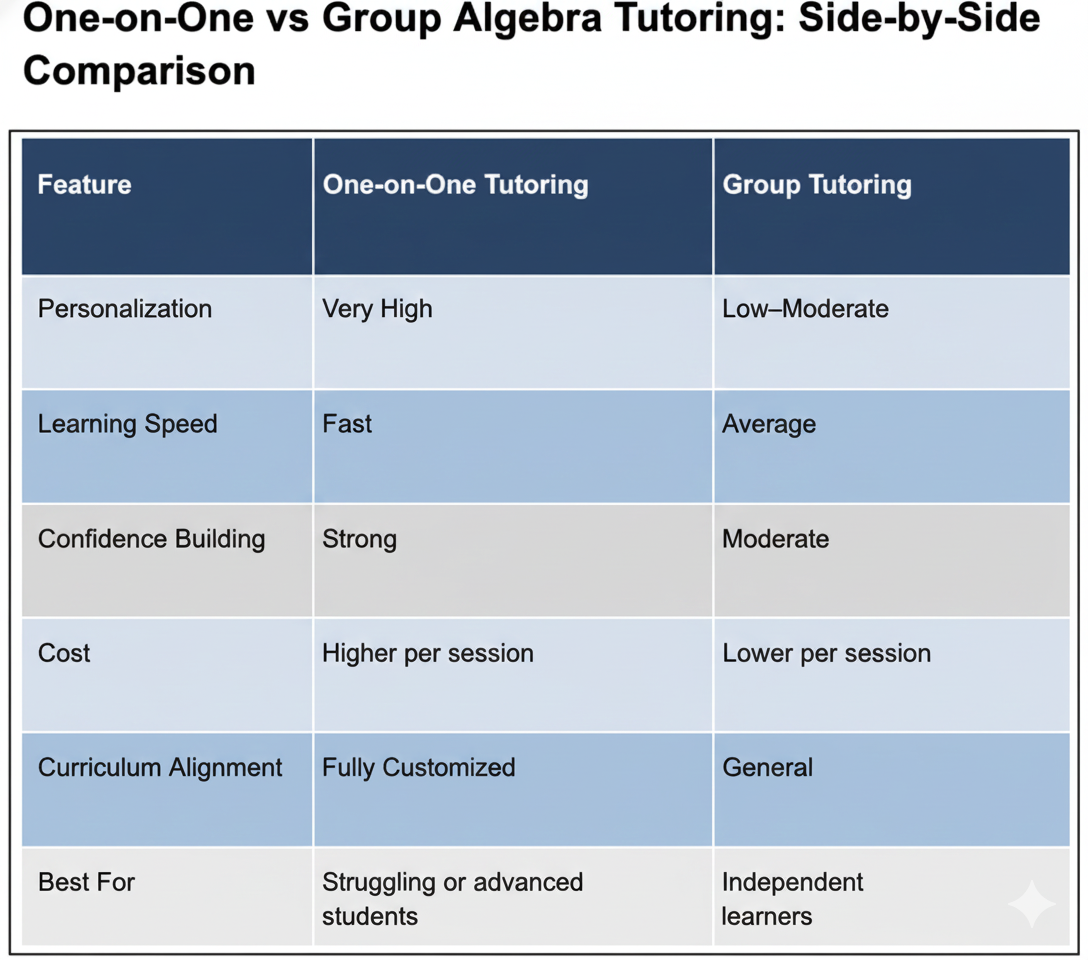
One-on-one tutoring usually costs more per session than group tutoring. That’s the most common hesitation parents have.
However, many families find they need fewer sessions overall because progress happens faster. Instead of months of slow improvement, they see measurable changes within weeks.
Another consideration is social learning. Students who thrive in group discussions may miss peer interaction - although for students already struggling, this is rarely a disadvantage.
Group algebra tutoring places multiple students in the same session, often organized by grade or topic.
For some learners, this environment works well. It can feel familiar, similar to a classroom, and less intimidating than private instruction. Students hear others ask questions they hadn’t thought of themselves.
Group tutoring is also typically more affordable, making it appealing for families looking for supplemental support rather than intervention.
The challenge with group tutoring is attention.
Even in small groups, tutors must divide their focus. If your child doesn’t speak up - or doesn’t realize they’re confused - misunderstandings can go unnoticed.
Group sessions also move at an average pace. That sounds reasonable, but in reality:
For students already behind in Algebra, this can feel like school all over again - just online.
Parents often ask which option is “better.” The more useful question is which is more appropriate for your child’s situation.
One-on-one tutoring works best when:
Group tutoring works best when:
The mistake many families make is choosing based on price alone, rather than outcomes.
Over the past few years, online tutoring has become mainstream and not just because it’s convenient.
High-quality online algebra tutoring now offers:
For working parents and busy students, online one-on-one tutoring removes barriers without sacrificing quality.
Strong algebra skills don’t just help students pass a class. They affect:
When students finally understand Algebra, something shifts. Math becomes predictable instead of scary. Effort starts paying off. And students stop seeing themselves as “bad at math.”
That change is often what parents value most.
Most parents don’t sit down and say, “Today I’m choosing between one-on-one and group algebra tutoring.”
What actually happens is quieter.
Homework starts taking longer.
Your child says, “I studied, I swear.”
A test comes back with a grade that doesn’t match the effort you saw at the kitchen table.
So you start looking for help.
At first, tutoring feels like tutoring. Same goal. Same subject. Same promise: better grades. But the format matters more than most parents expect - especially in Algebra.
Here’s the question I always ask parents:
Not what you wish they did. What they actually do.
Some kids speak up immediately.
Many don’t.
A lot of them pretend they understand until the worksheet proves otherwise.
If your child is the type who stays quiet when confused, group tutoring often repeats the exact problem they’re already experiencing in school. More voices, more movement, same hesitation.
One-on-one tutoring changes the dynamic entirely. Confusion isn’t awkward. It’s expected. It’s the whole point of the session.
In elementary math, students can often survive by memorizing steps. In Algebra, that stops working.
Variables don’t care if you’re guessing.
Equations don’t reward partial understanding.
Word problems don’t forgive shaky foundations.
This is why Algebra 1 is where many U.S. students hit their first real academic wall - usually somewhere between grades 7 and 9, depending on the district.
Group tutoring tends to move forward once the lesson is explained.
One-on-one tutoring doesn’t move forward until the student understands.
That difference sounds small. In practice, it’s everything.
Parents often focus on grades. Students focus on something else entirely: how math makes them feel.
By the time many kids reach Algebra, they’ve already decided whether they’re “good at math” or not. That belief shapes how they approach every problem.
In group environments tutoring included students are constantly comparing:
If your child already doubts themselves, this comparison doesn’t motivate them. It shuts them down.
In one-on-one sessions, there’s no audience. No pressure to perform. Just work. And oddly enough, that’s when confidence starts rebuilding.
Not from praise - but from understanding.
Group algebra tutoring isn’t useless. It’s just limited.
It works best for students who:
For these students, group sessions can feel like structured practice.
But if your child has gaps - and most struggling algebra students do group tutoring can turn into passive listening. They follow along. They nod. They don’t interrupt.
Then the test arrives.
And nothing changes.
Parents often mistake attendance for progress. They are not the same thing.
Here’s what private algebra tutoring does well and why parents notice results faster.
It catches misunderstandings early.
It forces active participation.
It adapts when something isn’t working.
If a student doesn’t understand slope, the tutor doesn’t move on because the lesson plan says so. They stop. They reframe. They try another explanation.
That flexibility is almost impossible in a group.
Over time, students stop memorizing steps and start recognizing patterns. That’s when Algebra stops feeling random.
Yes, one-on-one tutoring usually costs more per session.
But here’s what parents often discover later:
group tutoring costs less per hour, but more per outcome.
Slower progress means more sessions.
More sessions mean longer dependence on tutoring.
Longer dependence often means frustration - for parents and students.
Families who switch to one-on-one tutoring often say the same thing:
“I wish we had done this earlier.”
Not because it was cheaper. Because it worked.
This happens more than parents realize.
A student’s grade improves slightly, but:
That usually means the student learned procedures, not understanding.
One-on-one tutoring focuses on understanding because it has to. There’s nowhere to hide confusion. And once understanding clicks, attitude often follows.
Not instantly. But noticeably.
To be fair, group tutoring makes sense in specific situations.
If your child is:
Then group tutoring can be enough.
The problem is when parents use group tutoring as a repair tool instead of a reinforcement tool. That’s when disappointment happens.
This is a very common path:
That last conclusion is usually wrong.
More often, the support simply wasn’t personal enough.
Choosing between one-on-one and group algebra tutoring isn’t really about tutoring.
It’s about deciding whether your child needs:
For students who are behind, frustrated, or losing confidence, one-on-one tutoring isn’t an upgrade. It’s a different solution entirely.
Algebra is one of the first subjects where effort alone isn’t enough. Students need clarity. And clarity usually comes from attention.
Not more worksheets.
Not more explanations.
More focused explanations.
If your child is struggling, choosing the right tutoring format now can save years of academic stress later.
And that’s a decision worth making carefully.
If your child is comfortable in math and simply needs reinforcement, group algebra tutoring may be enough.
But if your child is struggling - emotionally or academically - one-on-one algebra tutoring is usually the more effective investment, even if it costs more upfront.
Algebra is not a subject students should “just get through.” It’s a foundation. And foundations need to be built carefully, not rushed.
Choosing the right tutoring format now can prevent years of frustration later.

