
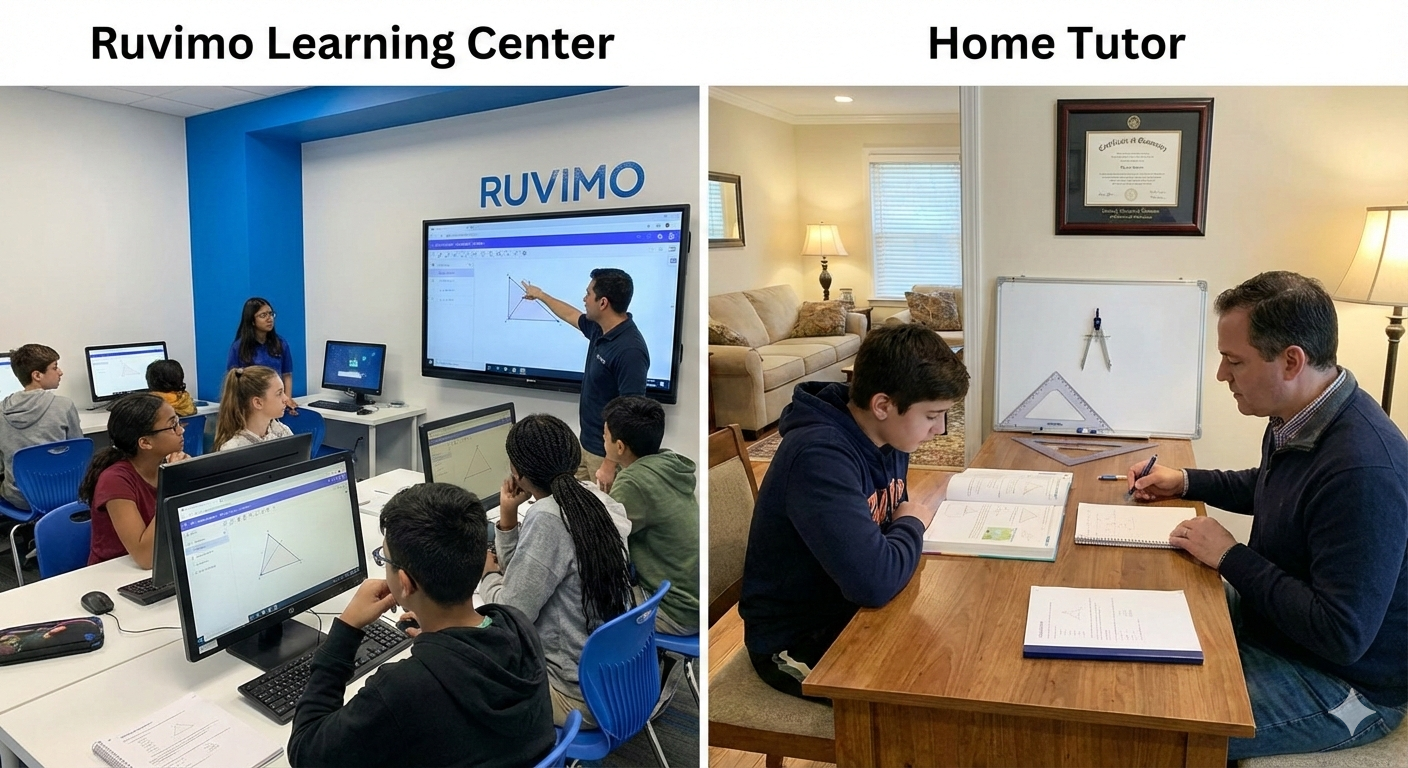

Geometry is sometimes a crossroad to students. It challenges them to stop doing simple calculations but instead need to do visual calculation and instead of doing what a step entails, they need to provide the reasons why a step is possible. The decision options are overwhelming to families that need support: should you get a local home tutor, sign up your child to an after-school program, or resort to a structured online system? Both of these options will assist, but all differences lie in terms of consistency, alignment with curriculum, fit with students and long-term value. It is in this comparison that I will take a close look at those differences as I am seeking to achieve one thing: assist families in making decisions that are not meant to offer a solution in a flash, but rather steady, reliable progress in Geometry.
Cramming is not a good thing to do in geometry. Quizzes and tests are rewarded with knowledge of relationships and explaining how to reason. A learner who knows how to get a solution but cannot explain the process would fail over and over again. Due to the fact that the skills of geometry are cumulative, one weakness leads to another. The support system that you choose must, thus, focus on the way a student thinks, and not necessarily what actions a student takes. It must continue the momentum during the school year and correlate with teacher expectation at school. The wrong kind of assistance usually leads to the repeated disappointment: you failed to hear the hint in the classroom, there are incongruent reactions, and it feels like you are not moving ahead.
A home tutor is also a direct individual contact and this is what many parents are drawn to. In case of a strong match, a tutor can identify the very point of confusion and change explanations on the spot in accordance with a learning style of a student. Experienced geometry teachers aid students in visualizing problems, taking them through the structure of proofs, and demonstrating ways of how algebra and geometry converse. A home tutor can make things emerge in students who react more to face-to-face attention or require to be taught through practical demonstrations.
Home tutoring is not standardized, however. Quality is all about the knowledge and experience the tutor has about the expectations in the U.S. classroom and his/her communication skills. A super algebraic manipulator will not find it easy to complete geometric proofs; a superb mathematician is not necessarily a superb teacher. In the absence of an agreed-upon plan or resources, the sessions will be reactive, centered on the ongoing homework instead of the development of lasting reasoning capabilities. The timetables may be ad hoc and tracking of progress may be done by means of informal notes or memory, instead of a well-known system. Good results are achieved when the right tutor is identified, and good results are lost when the match is poor, families may take months to find stability.
Another model is the after-school programs and group tutoring centers. The latter provide planned lessons, socialization with their peers, and a feeling of a common study space. This is inspiring to some students to listen to the methods that their peers are using, and different possible solutions. Group programs also have the advantage of providing regular meeting times that are more accommodating to families that desire regular support without the hassle of scheduling individual sessions.
Tradeoffs are involved with group formats. Teachers have to cater to various students hence the speed is forced to average. Those students who require additional remediation or a more challenging curriculum may fall behind or be bored. The content of the program might not be in accordance with the school curriculum of a student hence lowering relevance. Individualized feedback is also limited by group settings; misconceptions could be left unchanged since the instructor will not be able to dwell in the depth and breadth of thought in one of the students. After school programs are effective with motivated students who like peer discussion and structure. In the case of students requiring individual scaffolds, the students tend to lag behind.
Curriculum alignment-based online systems strive to take the best existing in the other models and lessen the areas of weaknesses. Such platforms match trained tutors with interactive devices, lesson progress, and lesson paths that reflect classroom speed. In the case of geometry, the possibility of dynamically drawing diagrams, rotating objects, and drawing comments in real time provides the student with a different experience with concepts that would be fixed on paper.
One of the key strengths is consistency. Students will be able to arrange regular meetings, tutors will keep the records of progress and families will have structured reports in order to know where the growth is taking place. Lessons are structured in such a way that they build on the previous lessons, which reduces the chances of the gaps accumulating over time. Since tutors in such sites are trained to deliver lessons according to U.S. standards, the lessons usually fit with what the students are exposed to in the classroom. And that implies that tutoring is not an alternative method that will only serve to confuse instead of benefit.
Instructional methods are also scaled on online systems. Explaining visuals are of high quality and can be reused by a well-thought tutor, and changed to suit a certain misconception of a student. When a family has work-life balance between activities and employment, the ability to work and log-in at home eliminates logistical burnout. To a great number of learners, virtual environment is not as unsightly as in a packed classroom, thus posing less difficulty to a learner in terms of posing questions and participating in class.
In measuring outcomes, some factors are important in families: understanding clarity, new problem applicability, progress consistency, and higher-level math readiness. Short term positive results can be achieved with high level of success by home tutors provided that they are concentrated on the specific needs, yet the successful result in terms of a long-lasting academic year is based on the constant presence and instructional competence. After-school programs provide exposure and community, but hardly any of the one-on-one feedforward a student requires to master proofs or complicated structures. Well-done structured online systems provide a balance: customized learning that is rhythmic in the school and instruments that help to bring abstract concepts to life.
Consider a student who has been having problems with triangle congruence and then comes to coordinate geometry. The immediate confusion can be removed using examples by a home tutor. A group during the after-school may follow the same content that is covered in class with minimal follow-up. The progress tracker in the form of an online program might identify the common mistakes and set specific practice, as well as go back to the basics until the next unit. Such systematic enforcement can lead over time to deeper insight.
One of the main but not given serious attention is the emotional reaction of a student to every format. There are students who are comfortable in the confines of a homestead tutoring session. They value the bodily presence of a teacher and the attentive conversation. Scheduling and commuting is disruptive to others and motivation to a private tutor is weak due to the sporadic nature. Group programs are effective among the students who love social learning and the advantage of observing various strategies. However, shy and easily distracted students might get less.
Online tutoring is likely to succeed with students who are more at ease with computer interfaces and who tend to feel more comfortable with a virtual tutor in a quiet one on one environment. It can as well assist students to grow up to be independent learners, as the sessions commonly mix up the training with directed practice which the student carries out between the meetings. Practically, the model is frequently accomplished by student fit rather than the model itself. The one most significant predictor of the steady improvement is a good fit between the teaching technique and the learning preference.
There are a number of reasons why geometry is a high stakes subject: it is a standardized test, it plays a central role in subsequent math classes and its thinking abilities are applicable in other fields. This is what renders curriculum alignment to be a critical issue. A tutor or a program that includes material other than school textbook can cause confusion among the student. Equally, practicing procedures without subjecting students to the kind of logic that they are tested on the SAT or the ACT is myopic.
There is a great variety of home tutors because they are more familiar with certain district standards and test styles. After-school programs tend to utilize generalized materials that aim at serving a number of curricula. The online systems that construct the lessons based on the U.S. standards and the ones that prepare the students in the common assessment formats provide a benefit to the families who are concerned with college readiness. These systems are able to run problem sets that are tailored to the style and timing of standardized questions whilst keeping a track of the underlying reasoning.
Geometry takes advantage of graphical and interactive applications. The capability to manipulate a figure, test a hypothesis, or bring into life a transformation makes ideas much more clear than the diagrams. Home tutors occasionally carry around manipulatives or can use a whiteboard but the size and quality of digital media is often restricted. The programs after school might be denied the use of individualized, high-quality interactive platforms.
In this respect, online systems are superior. They are frequently instructed by means of shared screens, dynamic geometry software and step by step annotation tools, which enable it to be easily demonstrated why a construction is worked or why a transformation impacts on coordinates. Reusable explanations are also formed by these tools. Learners are able to go through recorded lessons and understand how a tutor actually solved a problem, which assists in the consolidation of intersession learning.
Continuous improvement can never be facilitated by occasional assistance, it must have feedback loops. Occasional informal notes or occasional updates are some times given by home tutors, and tracking is usually ad hoc. Group programs could provide progress reports, but these reports tend to be attendance-based not tied to any particular skill acquisition.
Formatted online learning environments often have an inherent tracking system lesson results, error rates, and developmental statistics with the result that it is simple to show parents and tutors what is deviating and what requires additional focus. Such responsibility allows avoiding the undetected gaps and facilitates focused planning. This will enable the families to make informed choices on where to direct their energy and ways of celebrating improvements that count in academic life.
Cost is understandable in families, however, value should be the yardstick. It is not merely the amount of money that is thrown at an educational institution but what is yielded of that investment in the long term in confidence, clarity of concept and preparation in future classes. A system that develops competency and autonomy is preferable to one that involves corrections in the course that have to be done again and again or have temporary advantages.
The questions that families need to consider when comparing choices are: is this support option consistent? Is it in line with the school of the student? Does it give instruments that render reasoning apparent? Does it monitor improvement on any meaning? The responses differentiate short-term solutions and long-term solutions.
In some cases, it is possible to find instances in which home tutors or after-school centers may be the most suitable short-term option. Home tutoring may be perfect in the case of a student where demonstration is required, or there is a very narrow short-term gap that a professional tutor may be able to cover in a short time. After-school programs can be the correct choice of those students who have a study routine after school and peer encouragement.
Nevertheless, to achieve the greatest success, families are to seek some specifics: a tutor, who is familiar with a local curriculum and can provide systematic feedback or after-school program that utilizes some specific practice that is aimed at eliminating gaps and developing a line of reasoning. The format will not produce uniform results without these qualities.
The structured online systems are likely to gain popularity as they are an easy-to-use package that has alignment, tools, and accountability. An effective online course educates tutors to explicitly teach geometric reasoning, develops lesson routes that are in classroom time, and offers interactional resources that can be accessed by students on their own. To busy families, the ability to schedule when and where is involved; to the students, the availability of good visual materials and the recorded lessons can make the comprehension process much faster.
An example is Ruvimo where consistency in development in accordance with the school standards is upheld and tutors are employed who have been trained to help U.S learners through the reasoning processes that Geometry involves. Families that want to make sure that they have reliable growth and at the same time achieve academic alignment often discover that organized online assistance is the best investment they make.
A decision between these two has to be made based on the needs of the students, family logistics, and long-term objectives. Start by evaluating the learning style and the recent performance trends of the student. Is the student best a face-to-face student? Do they require some direct practical assistance? Do they have a tight schedule that is better met by flexible schedules? The next step is to assess the quality of tutor/programs available: are they related to the curriculum of the school, and can they be measured to show progress?
Lastly, there is sustainability. Geometry is not a one time problem that can be solved; it is a series of skills that build up. The best support is the one that ensures continued improvement of the student, ensuring the development of reasoning abilities that will be transferred to other subjects, and alleviating the burden of homework and test readiness in the long-term.
In case you are not even sure where to start, you may consider a short trial period, with the option that fits your student learning choice the best. When you hire a home tutor, begin with a clear evaluation and a written schedule during several weeks. When you select an after-school program, make sure that the instructors are monitoring personal progress and that the materials used are the same as those used in the classroom with your child. Should you give an online system a test drive, you want to seek platforms that deliver a diagnostic, a roadmap which is within the school pacing, as well as frequent updates on progress.
It can never be otherwise because geometry pays clear thinking more than practice. The most optimal learning alternative will be the one that learners are taught on how to think in problems, offers constant reinforcement, and is practical in the family. Home tutors may work well when the right fit is located; after-school programs provide structure and peer education that fit some students; structured online systems may provide curriculum fit, interactive tools, and good tracking in a manner that tends to bring the most stable long-term outcomes. Families placing emphasis on alignment, consistency and emotional fit of the student will opt to support the student to actual understanding as opposed to short term solutions. When you want to achieve gradual progress and be prepared to solve math-related problems in the future, you should focus on the established instruction, quantifiable progress, and the learning environment that will enable the student to become an independent and confident problem solver.
Teacher Christi is an engineer and educator currently teaching at a leading state university in the Philippines. She is pursuing a Master of Science in Teaching (Physics) and is also a licensed professional teacher in Mathematics. With a strong foundation in engineering, physics, and math, she brings analytical thinking and real-world application into her classes. She encourages hands-on learning and motivates students to view mathematics as a powerful tool for understanding the world. Beyond the classroom, she enjoys reading and exploring history, enriching her perspective as a dedicated academic and lifelong learner.

