

Understanding integers doesn’t require you to be a math expert. It requires the right visual tools, relatable examples, and a shift in how you approach the concept. This guide will show you exactly how to help your child master positive and negative integers using methods that work - without passing on math anxiety. Recognizing the importance of negative numbers is crucial, as a strong grasp of this concept lays the foundation for future success in algebra, advanced math, and real-world problem solving.
Before we dive into strategies, let’s talk about why this topic deserves your attention. Integers aren’t just abstract numbers your child needs to memorize for a test. Research confirms that “understanding the conceptual aspects of integers and demonstrating the ability to work successfully with integer operations is a foundation for algebra.”
Natural numbers are the counting numbers starting from 1 (1, 2, 3, ...), and are also called positive integers. Whole numbers include all natural numbers plus zero (0, 1, 2, 3, ...). Understanding the difference between natural numbers, whole numbers, and positive integers is key to building a strong foundation in arithmetic and number classifications.
Think of algebra as the gatekeeper to higher mathematics, STEM careers, and even college admission. Positive integers (natural numbers) are the building blocks for understanding more complex numbers like negative integers. Students who struggle with integers in middle school often hit a wall when they reach Algebra I - not because algebra itself is impossible, but because they’re missing the foundational understanding of how negative numbers behave.
According to Common Core standards, sixth graders should understand integers as numbers describing opposite directions (temperature above and below zero, elevation above and below sea level). By seventh grade, they need to fluently add, subtract, multiply, and divide these numbers. By eighth grade, they’re using integers in complex equations. The learning builds quickly - which is why getting it right in sixth and seventh grade is crucial.
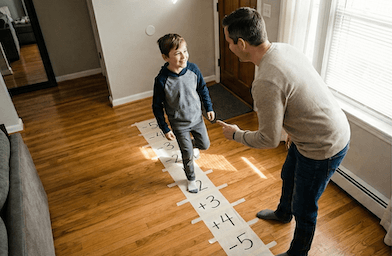
Of all the tools available to teach integers, the number line is the most powerful - especially when you make it big enough to walk on. The number line can be used to represent not only integers, but also all real numbers, including fractions and decimals.
Here's a strategy that mathematics educators call a game-changer: create a number line on your floor using masking tape. Mark integers from -10 to +10 at regular intervals (about one foot apart works well). Have your child stand on zero.
Now call out a problem: "Start at zero. Add 3." Your child walks three steps to the right, landing on +3.
"Now subtract 5." Your child walks five steps to the left, landing on -2.
This physical movement does something remarkable: it transforms an abstract concept into a concrete experience. Teachers who use this method report students saying, "Why has no one shown us this before?" The kinesthetic approach activates different parts of the brain and helps the concept stick.
The key insight: Moving right means adding or going positive. Moving left means subtracting or going negative. When your child physically feels the direction change, integers stop being arbitrary rules and start making intuitive sense.
While textbooks typically show horizontal number lines, consider starting with a vertical number line instead - like a thermometer.
Why? Because vertical thermometers mirror something your child already understands: temperature. Everyone naturally grasps that zero degrees is the reference point, numbers above zero are called positive and numbers below zero are called negative. When you ask, “Which is colder, -8°C or -3°C?” your child instinctively knows -8 is colder, even if they might incorrectly think -8 is “bigger” in abstract terms.
This connection between spatial position and numerical value helps prevent one of the most common misconceptions: that -8 is greater than -3 because 8 is a bigger digit.
Research has identified specific errors that trip up most students learning integers. Using clear words and explanations is essential to help students avoid common misconceptions about integers. If you can spot these misconceptions early and address them directly, you’ll save your child months of confusion.
What it looks like: Your child says -8 is greater than -3 because 8 is bigger than 3.
How to fix it: Use the thermometer analogy consistently. Ask comparison questions about temperature, elevation below sea level, or debt. “Would you rather owe $8 or $3? Which is better for you?” Remind your child that the confusion often comes from thinking the number with the larger digit is the larger number, but on the number line, -3 is actually the larger number compared to -8.
What it looks like: Your child calculates -3 + (-4) = 7.
How to fix it: Clarify that “two negatives make a positive” only applies when you’re multiplying or dividing, or when you’re subtracting a negative. For addition, explain that when you add two negative numbers, you are combining two negative quantities - so you end up with a sum that is even more negative. Use the language: “You’re combining two negative quantities - you have more debt, more cold, more below sea level.”
What it looks like: Your child doesn’t know whether the minus sign means “negative number,” “subtract this,” or “the opposite of.”
How to fix it: Use different language for different meanings. For the negative sign in front of a number (-5), say “negative five.” For the subtraction operation (8 - 3), say “eight minus three.” For the opposite (the opposite of 5 is -5), say “the opposite of five.” Some parents find it helpful to use different colored markers for each meaning when writing problems.
Note: The minus sign can represent a negative number (as in -5), indicate subtraction (as in 8 - 3), or show the opposite of a value (as in the opposite of 5 is -5). Clarifying these uses helps students avoid confusion.
What it looks like: Your child treats -5 + 3 as if it’s 5 + 3 = 8.
How to fix it: Before solving any problem, have your child circle or highlight all negative signs with a colored marker. This simple physical action forces a person to focus on those critical symbols and helps avoid mistakes by making the operation clearer.
What it looks like: Your child assumes subtraction is commutative, thinking 5 - 7 equals 7 - 5.
How to fix it: Go back to those real-world contexts. “If you have $5 and spend $7, is that the same as having $7 and spending $5?” The answer becomes obviously different when grounded in reality. Explain that when you subtract two numbers, the order matters - subtracting a larger number from a smaller one can result in a negative number, while reversing the two numbers gives a different result.
What it looks like: Your child isn't sure if zero is positive or negative.
How to fix it: Explain that zero is the reference point - it's neither positive nor negative, just like you're not older or younger than yourself. Zero is where positive and negative meet, the starting line, the neutral point.
Abstract numbers don’t engage middle schoolers. But money, video games, and weather? Those get attention. Practice questions based on real-world scenarios can help reinforce understanding of integer operations.
Check your local weather forecast together. Create a vertical number line and track daily temperatures for a week. Ask questions like:
Middle school is when many kids start thinking about money more seriously. Calculations involving positive and negative balances help students understand integer operations in real life. Frame problems in terms of allowance, savings, and spending:
Minecraft players already understand Y-coordinates going negative when you dig underground. Gamers track health points where damage is negative and healing is positive. Use your child’s gaming experience:
Show your child that elevations are expressed as positive numbers above sea level and negative numbers below sea level. For example, Death Valley is 282 feet below sea level (-282 feet) while Mount Everest is 29,032 feet above sea level (+29,032 feet). Submarines dive to negative depths, airplanes climb to positive altitudes. These concrete images give abstract numbers physical meaning.
When your child asks why the rules work the way they do, resist the urge to say “That’s just how it is” or “You’ll understand when you’re older.” Middle schoolers are developmentally ready to understand the logic - and research shows that conceptual understanding leads to better retention than memorized rules. Following rules for integer operations ensures mathematical consistency and helps students understand why these rules work.
The hot air balloon model makes this intuitive: Imagine the balloon is your number. Adding sandbags (adding negative weight) makes it go down. Subtracting negative numbers, or subtracting a negative, is like removing negative weight, which makes the balloon go up. So, subtracting a negative number, such as 5 - (-3), means “starting at 5, remove 3 sandbags,” which makes the balloon rise to 8. In other words, subtracting a negative number produces the same result as adding its positive counterpart.
Another approach: Think about language. If someone says “Do not eat,” that’s negative. But if they say “Do NOT not eat,” the double negative becomes positive - they’re saying to eat.
Use pattern recognition rather than arbitrary rules. Write this sequence with your child:
Ask: “What pattern do you notice?” Each time the first number decreases by 1, the product increases by 2. Following that pattern:
This isn’t magic - it’s mathematical consistency. When multiplying two numbers with the same sign, such as -1 × -2, the result has a positive sign. If the numbers have different signs (unlike signs), the result is negative. The sign of the product depends on whether the numbers have the same sign or different signs. The order of multiplication (first number and second number) does not affect the result, but the rules for signs always apply. The pattern requiresnegative times negative to equal positive, demonstrating why multiplying two negatives gives a positive sign.
If you’ve ever wondered why your child’s math homework suddenly starts talking about “absolute value,” you’re not alone. Absolute value is one of those ideas that sounds complicated, but is actually all about something your child already understands: distance.
Absolute value simply means how far a number is from zero on the number line, no matter which direction you go. It’s written with two straight lines, like this: |x|. The absolute value of a number is always positive or zero - never negative - because distance can’t be less than zero.
For example, the absolute value of -5 is 5, and the absolute value of 5 is also 5. Both are five steps away from zero, just in opposite directions. This is why absolute value is so helpful when working with positive and negative numbers: it lets us focus on the size, or magnitude, of a number, not its direction.
Why does this matter? Understanding absolute value helps students compare positive and negative values, solve equations, and make sense of real-world situations. For instance, if the temperature drops from 3°F to -4°F, the difference is |3 - (-4)| = |7| = 7 degrees. Whether you’re above or below zero, the absolute value tells you the total change.
While the number line excels for addition and subtraction, it becomes abstract for multiplication and division. That’s when two-color counters become invaluable.
You can buy a set for about $8 online, or make your own using dried beans (paint half red, leave half white), coins, or cut paper circles.
The system:
To model -3 + 5:
When adding two positive numbers with counters, the process is straightforward - simply count out the total number of yellow chips, since all counters are the same color.
The beauty of this model is showing that -4 can be represented multiple ways: 4 red chips alone, OR 5 red + 1 yellow (cancel the pair, 4 red remain), OR 6 red + 2 yellow. This demonstrates that integers have multiple representations - a concept that becomes critical in algebra.
How do you know if your child's struggle is normal middle school adjustment or something requiring additional support?
Normal challenges include:
Signs that extra support may help:
If you notice these patterns, consider reaching out to your child's teacher first to understand what's happening in class. Professional math tutoring can provide the individualized support and confidence-building some students need, especially when concepts weren't fully mastered in earlier grades.
Remember that statistic from the beginning? Math-anxious parents who help frequently can inadvertently harm their children's learning. But the solution isn't to stop helping - it's to help differently.
Instead of saying:
Try saying:
The research is clear: children absorb their parents' attitudes about math. A study tracking 3,520 students over five years found that hard work and good study habits - not innate ability - were the most important factors in improving math achievement.
When your child says "I can't do this," add one powerful word: "yet." Transform "I can't solve negative number problems" into "I can't solve negative number problems yet." That single syllable changes a fixed statement into one with possibility.
Your sixth or seventh grader might ask, “When will I ever use this?” Here’s the honest answer:
Integers are the language of algebra. Every algebraic equation can involve negative numbers. Understanding negative numbers is essential for solving quadratic equations, which often have negative solutions. Graphing in all four quadrants of a coordinate plane requires integer fluency. Solving inequalities requires understanding what happens when you multiply by a negative. Simplifying expressions with subtraction requires mastering integer operations.
Recent research on the transition from arithmetic to algebra identifies a “cognitive gap” that challenges many students. Integers form the bridge across that gap. Students who develop solid integer understanding in middle school find algebra logical and accessible. Those who memorize rules without understanding hit roadblocks when algebra demands flexibility and reasoning.
Teaching integers doesn't require a math degree - it requires patience, the right tools, and real-world connections. The number line, especially the life-sized floor version, transforms abstract concepts into physical experiences. Two-color counters make operations visible and manipulable. Real-world contexts like temperature, money, and elevation give numbers meaning.
Most importantly, your approach matters more than your math background. When you model persistence, curiosity, and a growth mindset - when you say "Let's figure this out" instead of "I can't help you" - you give your child something more valuable than answers. You give them the confidence to tackle challenges.
Integers are just the beginning. They're the foundation for pre-algebra, algebra, and all the mathematics that follows. Get this right, with understanding rather than memorization, and you're not just helping with homework - you're opening doors to your child's future.
Looking for additional support with pre-algebra concepts? Ruvimo offers quality math tutoring at affordable rates, helping students build strong foundations in middle school mathematics. Our experienced tutors use research-based methods to ensure conceptual understanding, not just rule memorization.
The opposite of a positive integer is its negative counterpart — for example, the opposite of 5 is -5. Absolute value refers to a number's distance from zero on the number line, so the absolute value of both 5 and -5 is 5. Understanding this distinction helps students avoid confusing the minus sign as simply meaning 'negative' when it can also mean 'the opposite of' a value.
Yes — subtracting a negative number produces the same result as adding its positive counterpart. For example, 5 - (-3) equals 5 + 3 = 8. This is because the two negative signs cancel each other out. The article notes this is one key exception to the common misconception that 'two negatives always make a positive,' which only applies during multiplication, division, or when subtracting a negative.
It's complicated because students must track what the minus sign means — is it subtraction, a negative number, or 'the opposite of'? That layered meaning causes real confusion. It's simple once students understand the rule: subtracting a negative is the same as adding a positive. A number line or floor-walking activity can make this click quickly, turning what feels abstract into an intuitive, concrete experience.
The article identifies the number line as the most powerful tool, especially when made life-sized on the floor with masking tape. Having a child physically walk left or right to represent adding or subtracting integers turns an abstract concept into a concrete experience. Teachers who use this method report students saying, 'Why has no one shown us this before?' The kinesthetic approach helps concepts stick.
This misconception happens because students apply whole-number logic — a bigger digit must mean a bigger number. To fix it, use the thermometer analogy: ask 'Would you rather owe $8 or $3?' or 'Which temperature is colder?' On a vertical number line, it's visually clear that -8 sits below -3, making -3 the larger number. Consistent use of real-world comparisons corrects this misunderstanding effectively.
The rule that two negatives make a positive only applies when multiplying or dividing two negative numbers, or when subtracting a negative number. It does not apply to addition. For example, -3 + (-4) = -7, not +7. Adding two negative numbers means combining two negative quantities, making the result even more negative. Using language like 'more debt' or 'more cold' helps children understand why the sum grows more negative.
According to the article, integers are the foundation for algebra, which is itself the gateway to higher math, STEM careers, and college admission. Common Core standards expect sixth graders to understand integers as opposite directions, seventh graders to fluently compute with them, and eighth graders to use them in complex equations. Students who miss this foundation in middle school often struggle in Algebra I — not because algebra is too hard, but because the groundwork is shaky.
Jude is a compassionate Filipino educator whose unique blend of nursing expertise and tutoring experience allows him to support learners with both skill and sincerity. Since 2019, he has taught English to students of all ages and has also spent the last two years helping learners strengthen their understanding of Mathematics. He tailors each lesson to fit every student’s learning style and goals, whether they want to speak English more confidently, excel in math, or develop effective study habits. Known for his warm personality and patient guidance, Jude creates an online learning environment where students feel encouraged, motivated, and capable of achieving real progress. His mix of professional discipline and genuine care makes him a reliable mentor in every learner’s academic journey.

