
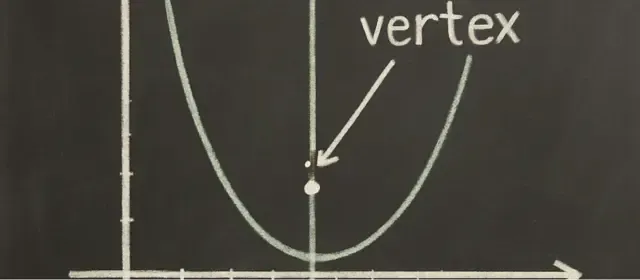
Understanding the Logic and Power of the Vertex
A vertex is an aspect where one or more curves, lines, or line segments meet or intersect. Think of it as a mathematical “corner” , the appropriate place where distinct elements come together. The time period comes from the Latin word “vertex,” which means “maximum element” or “top.”
At its most basic level, a vertex is simply a meeting point, the corner where two lines or edges intersect. However, as a student advances from foundational geometry into 7th-grade algebra and eventually complex calculus, they will realize that these points serve a much more sophisticated purpose.
Vertices in Geometry: The Foundation
2D Shapes and Polygons
In 2-D geometry, vertices are the corners of polygons. Every polygon, from the simplest triangle to complex multi-sided figures, is described by using its vertices. Here are a few key examples:
- Triangles: 3 vertices, wherein each vertex is formed using the intersection of aspects
- Quadrilaterals: 4 vertices, including squares, rectangles, parallelograms, and trapezoids
- Pentagons: 5 vertices, and so 4th for higher-order polygons
Understanding vertices in 2D shapes is fundamental for students at all levels. Our algebra math tutoring programs often begin with those primary standards earlier than progressing to advanced programs.
3-D Shapes and Polyhedra
In higher geometry, a vertex is the point where three or more edges meet. Three-dimensional shapes add complexity to the vertex idea:
- Cubes: They have 8 vertices, where 3 edges meet at every corner
- Pyramids: The vertices rely on the base shape (a triangular pyramid has 4 vertices)
- Prisms: They have vertices where the parallel faces connect with the square sides
Understanding 3D vertices enables college students to visualize spatial relationships and prepares them for more advanced topics in calculus and analytical geometry.
The Vertex in Algebra: Parabolas and Quadratic Functions
As students progress to algebra 2, the concept of the vertex takes on new meaning within the context of quadratic functions and parabolas. This is where many students benefit from online algebra tutoring to fully grasp the concepts.
The Parabola’s Vertex
The vertex of a parabola is used to locate the coordinates of the point where the parabola crosses its axis of symmetry. The vertex is the highest or lowest point, also known as the most or least, of a parabola.
For a quadratic characteristic in the form y = ax² + bx + c, the vertex represents the turning point of the parabola. This point has precise importance:
- If ’a is extraordinary, the parabola opens upward, and the vertex represents the minimal factor
- If ’a is bad, the parabola opens downward, and the vertex represents the most aspect
Finding the Vertex: Mathematical Methods
Method 1: The Vertex Formula (The Direct Approach)
For students working with a standard quadratic equation in the form _ax_2 + bx + c = 0, the Vertex Formula is often the most efficient route. By using the formula x=-b/2a, you can quickly identify the center line of the parabola. Once you have this x-coordinate, you simply plug it back into your original equation to find the corresponding y-value. This is the “bread and butter” of high school algebra because it’s fast and reliable.
Method 2: Completing the Square (The Structural Approach)
If you want to see the “skeleton” of the math, completing the square is the way to go. This algebraic technique transforms a standard equation into Vertex Form:
y = a (x - h)2 + k
In this format, you don’t even need to calculate anything to find the vertex, it is simply (h, k). While this method requires a few more algebraic steps, it is favoured by mentors because it reveals the horizontal and vertical shifts of the graph, giving the student a much better feel for how the parabola sits on the plane.
Method 3: Using Calculus (The Advanced Route)
For university students or those working with a calculus mentor, finding the vertex becomes a lesson in rates of change. Since the vertex represents the exact moment a curve stops going down and starts going up (or vice versa), the slope at that point is exactly zero. By taking the derivative of the function and setting it to zero, you can locate the critical point, which, in a quadratic, is always the vertex. This method is a fantastic way to bridge the gap between basic algebra and the predictive power of higher mathematics.
Real-World Applications of Vertices
Engineering and Architecture: The Blueprint of Stability
In the physical world, vertices are the literal joints that hold our infrastructure together. Architects and structural engineers rely on vertex calculations to design everything from the geometric patterns in a modern skyscraper to the complex frameworks of a bridge. Because a vertex represents the point where forces meet, calculating these coordinates with precision is vital for ensuring the structural integrity and safety of any building project.
Computer Graphics and Game Design: The Digital Skeleton
In digital media and game development, every character you see on screen is built from a “wireframe” composed of thousands of vertices. These points are connected by edges to create faces, forming the 3D meshes that make up realistic objects and animations. By manipulating these vertices, designers can change the facial expressions of a character or the terrain of a virtual world, making it the most fundamental skill in the toolkit of a modern animator.
Physics and Motion: Capturing the Peak
When scientists study projectile motion or optimization problems, the vertex of a parabola becomes the most important data point. In physics, the vertex often represents the maximum height reached by an object or the point of “best angle” for maximum efficiency. Whether it’s calculating the arc of a satellite launch or the path of a basketball, identifying the vertex allows us to predict the exact moment a system reaches its peak performance.
Teaching and Learning Vertices: Educational Approaches
At Ruvimo, we recognize that every student processes spatial information differently. Our online math tutoring methodology is built to accommodate various learning styles, ensuring the concept of the vertex moves from a “dot on a page” to a functional tool in the student’s mind.
Visual Learning: Seeing the Turning Point
Many students grasp the concept of a vertex much faster when they can see it in action. We use interactive graphing and dynamic demonstrations to illustrate how a vertex functions in real-time. By visualizing how a parabola shifts or how a 3D shape changes as its anchor points move, students can internalize the geometry without being overwhelmed by abstract formulas.
Digital “Hands-On” Activities: Tactile Discovery
Even in a digital environment, we prioritize tactile engagement. For younger learners in 7th-grade math or advanced students tackling the curves of calculus, we utilize virtual manipulatives and 3D modeling software. These tools allow students to touch and manipulate vertices, edges, and faces, turning a static lesson into a discovery-based experience that builds lasting spatial intuition.
Step-by-Step Scaffolding: Mastering the Process
Our approach to problem-solving is designed to prevent math dread by breaking complex vertex problems into manageable, logical steps. Rather than rushing to the answer, our tutors focus on scaffolding, ensuring a student understands the “why” behind each coordinate before moving to the next level of complexity. This method builds the problem-solving stamina and confidence required to handle everything from basic algebra to high-level engineering challenges.
Common Challenges and Solutions
Students sometimes face problems while studying about vertices:
1. The Visualization Gap
Many students find it difficult to move from a flat diagram to a three-dimensional mental map. Visualizing how vertices connect and interact in a 3D space is a specialized spatial reasoning skill that doesn’t always develop automatically. To bridge this gap, they utilize specialized software and interactive models that allow students to rotate and explore shapes from every angle. This makes the relationship between coordinates and physical space far more intuitive.
2. The Algebra “Maze”
Even when a student can “see” the vertex, finding it algebraically can feel like a maze. Converting between different forms of a quadratic equation, such as moving from standard form _ax_2 + bx + c = 0 to vertex form y = a (x - h)2 + k, requires precise algebraic manipulation and a solid grasp of the ‘why’ behind each step. They focus on building these core manipulation skills so that switching between forms becomes a tool for understanding rather than just a memorized trick.
3. Decoding Word Problems
The most common frustration often comes from application traps. Real-world problems rarely hand you a clean equation, instead they give you a verbal description of a maximum height or a starting point. This requires the ability to translate text into a mathematical expression, a skill that is as much about literacy as it is about math. By providing extensive practice with these word problems, they help students learn to decode the language and identify the hidden vertex within the story.
Mastering High-Level Vertex Applications
Calculus: The Gateway to Optimization
In calculus, vertices are no longer just points on a graph; they represent critical points where a function reaches its peak or its lowest valley. By analyzing the relationship between vertices and derivatives, students learn to solve optimization problems, the math behind finding the highest trajectory of a rocket or the minimum cost for a production line.
When a student works with a mentor to identify where the derivative f’(x) = 0, they are doing more than just algebra, they are uncovering the exact moment of change in a system. This deeper curve analysis allows learners to predict behavior in physics, economics, and engineering with pinpoint accuracy.
Graph Theory: The Architecture of the Digital World
In discrete mathematics and computer science, the meaning of a vertex expands into the foundation of network analysis. Here, vertices (often called “nodes”) represent individual entities, such as people in a social network, routers on the internet, or cities on a map, while edges represent the relationships between them.
This application moves far beyond geometric shapes and into the realm of algorithmic thinking. Understanding how vertices interact within a network is the key to mastering data structures and building the logic that powers everything from GPS navigation to social media algorithms.
Linear Programming: Solving for the Best Outcome
In the world of logistics and business strategy, vertices play a critical role in Linear Programming. When a company needs to maximize profit under several constraints, they map out a feasible region on a graph. The Optimal Solution to these multi-variable problems almost always occurs at one of the vertices (or corners) of this region.
By mastering these corner-point solutions, students learn how to make data-driven decisions in complex environments. This proves that a single point on a coordinate plane can hold the answer to a multi-million dollar logistics challenge.
4 Proven Strategies for Building Vertex Mastery
Success with vertices calls for consistent practice and the right steering:
Prioritize Geometric Foundations: Solidify basic geometry before advancing to Algebra 2. Understanding these “building blocks” early prevents conceptual hurdles later.
Build Resilience Through Practice: Consistent exposure to varied vertex problems develops the “problem-solving stamina” required for academic growth and standardized testing.
Invest in Human Mentorship: Unlike automated tools, a human mentor identifies specific “cognitive traps” and provides the psychological support needed to overcome math anxiety.
Balance Tech with Logic: Use graphing software as a tool for visualization, but ensure you maintain the algebraic skills to solve problems manually.
Conclusion: Building STEM Confidence One Vertex at a Time
Mastering the vertex is a critical milestone that marks a student’s transition from basic geometry to complex algebraic analysis. Whether you are identifying the corners of a simple shape or the maximum turning point of a calculus function, these coordinates serve as the essential bridge between foundational math and advanced problem-solving.
This progression, from geometry to algebra to calculus, demonstrates the interconnected nature of mathematics. It proves that a single point on a graph is never just an isolated coordinate; it is a foundational building block for future STEM success.
At Ruvimo, we move beyond the instant answer culture to help students develop a true conceptual understanding. Our human-led tutoring methodology ensures that students do not just memorize formulas, but build the cognitive resilience and problem-solving stamina required to apply these concepts in real-world scenarios.
By focusing on the “why” behind every vertex, we empower learners to navigate the productive struggle and build a sturdy foundation for their academic future.
Frequently Asked Questions
What is the definition of a vertex in math?
A vertex is a point where one or more curves, lines, or line segments meet or intersect. Think of it as a mathematical “corner”, the place where distinct elements come together. The word comes from the Latin “vertex,” meaning “maximum element” or “top.” At its most basic, a vertex is simply a meeting point where two lines or edges intersect.
What is the definition of vertices in geometry?
In geometry, vertices (the plural of vertex) are the corners of shapes. In 2D geometry, they are the corners of polygons, for example, a triangle has 3 vertices and a square has 4. In 3D geometry, a vertex is the point where three or more edges meet, such as the 8 vertices of a cube or the apex of a pyramid.
What does vertex mean in math for kids in middle school?
For middle school students, a vertex is most commonly the corner point of a 2D or 3D shape. A triangle has 3 vertices, a pentagon has 5, and a cube has 8. As students advance into algebra, the term also describes the highest or lowest point of a parabola, the turning point of a quadratic function graphed on a coordinate plane.
What is the vertex of a parabola in algebra?
The vertex of a parabola is the highest or lowest point on the curve, also called the maximum or minimum. For a quadratic function in the form y = ax² + bx + c, the vertex is the turning point. If ‘a’ is positive, the parabola opens upward and the vertex is the minimum point. If ‘a’ is negative, the parabola opens downward and the vertex is the maximum point.
How do you find the vertex of a quadratic equation?
There are three main methods. First, use the vertex formula: find the x-coordinate with x = -b/2a, then substitute it back into the equation to find y. Second, complete the square to rewrite the equation in vertex form y = a(x - h)² + k, where (h, k) is the vertex. Third, calculus students can take the derivative, set it to zero, and solve for the critical point.
What are vertex-disjoint simple cycles and why do they matter?
Vertex-disjoint simple cycles are cycles within a graph that share no vertices with each other. This concept comes from graph theory and combinatorics. It is studied in parameterized complexity research, which examines how efficiently certain mathematical problems can be solved. While advanced, it builds directly on the foundational idea of a vertex as a meeting point between edges in a mathematical structure.
Where are vertices used in the real world?
Vertices appear throughout everyday life. Architects and engineers use vertex calculations to design structurally sound buildings and bridges, since a vertex represents the point where forces meet. In computer graphics and game design, 3D models are built from thousands of vertices forming a wireframe mesh. In physics, the vertex of a parabola identifies the maximum height of a projectile, such as a basketball or satellite launch.