1-on-1 online tutoring
Online kindergarten math tutors
Counting, number sense and shapes, taught through play.
- From $36 an hour
- First session free, no card
- The same tutor every session


Reviewed by Kashyap Matani, Co-founder, Ruvimo
Kindergarten math tutoring covering counting and cardinality, 1-on-1 correspondence, and subitizing. Your child works with the same dedicated tutor every session, live and 1-on-1, so every foundational skill is built in the right sequence.
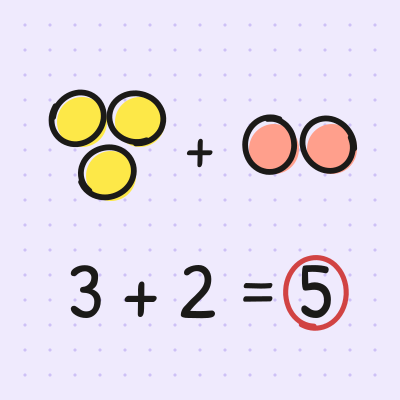
Kindergarten math builds the number sense every future math course depends on.
Counting, cardinality, and fact fluency within 5 sound simple. They aren't. Not when a five-year-old is learning them for the first time. Ruvimo tutors know exactly which kindergarten CCSS domains trip children up most (K.CC.B.4, K.OA.A.3) and how to make abstract ideas concrete before they're needed on an assessment. Sessions are live, unhurried, and built around what your child can actually do right now.
The free first session starts with a quick diagnostic: can your child answer 'how many?' without recounting? Can they generate two numbers that make 5? Do they count on, or always count all? Those three questions reveal where the cardinality and decomposition foundations stand, and the tutor builds from there, not from a one-size script.
Kindergartners build trust slowly. A child who is just getting comfortable with one tutor's pace, tone, and question style doesn't need to restart that process every few weeks. The same tutor session after session notices what works, which manipulatives click, which phrasing lands, and builds on it. That continuity is especially important at an age when math confidence forms for the first time.
Sessions align with what your child's school is currently teaching, whether that's Go Math, Eureka Math (EngageNY), or another Common Core-aligned curriculum. The tutor works with the same sequence your child's classroom follows: Counting and Cardinality first, then Operations and Algebraic Thinking, then early base-ten concepts. No confusion from a parallel system running alongside school.
The people who teach it
Tutors who teach kindergarten math

Reading and Math Tutor for Kinder up to Grade 6
View profile

Elementary Maths and ELA tutor
View profile

K-5 Math Teacher | Making Math Simple & Engaging | Fractions & Concept-Based Learning
View profile

Chemistry Teacher total of 8 years of experience
View profile

Certified Math Teacher | Personalized Learning | Proven Results
View profile

I don’t teach math, I teach students how to THINK
View profile
After you book
How the free kindergarten math session works
No card and nothing to decide first. If it is not right for your child, you owe nothing.
Pick a grade and a time
About a minute.
We call you
To hear what your child needs, so the tutor comes prepared.
Your child meets their tutor
45 minutes, live and 1-on-1.
- 16,000
- hours of 1-on-1 lessons taught
- 1,000+
- US students taught
- 200
- tutors on the team
- 90%
- parent satisfaction score
From other parents
What parents tell us
Four of them on video, unscripted, and more in their own words.
LeathaParent of a 6th grader“She was not reading fluently at all. Now she is reading 41 to 50 words a minute.”
JessicaParent of three“They all see the same tutor. He knows their names.”
A dadParent of a 7th grader“He was a straight-A student in sixth grade, then his grades were suffering. His grades have improved dramatically.”
MariaMom of three“They sign in by themselves. They look forward to these sessions.”
Ms. Shubhra works very well with my son. Her methods when teaching make it clear for my son to understand the lesson plan. Ms. Shubhra along with the lesson plan gives homework and goes over the homework with him. I especially love that I get a summary of how the session went and things that we as parents can work on with our child in terms of his academic plan and long-term goal.
Elementary math student's parent
I am very happy with Jude's teaching approach. He uses repetition effectively to ensure that Symphony understands the concepts and stays focused. He is calm and patient, even when she makes mistakes, which keeps the learning environment positive and encouraging. His approach has made a noticeable impact on Symphony's confidence. I would absolutely love for Jude to continue as her tutor long-term.
Elementary math student's parent
The tutor Ms. Richa made sure Tran got enough practice for her state exam. She recently got a 99th percentile in a statewide math exam. I am very happy with Ms. Richa. Her style of sending lesson notes and homework is one of the best things. I hope the English tutor sends it the same way.
Verified Parent
Pricing
Simple pricing
Your first 45-minute session is free. No credit card, no commitment. After that you buy sessions in a block and use them whenever you like.
FreeYour first 45-minute session
No credit card, no commitment.
8 sessions
$54per hour
$432 total for 8 sessions
- Valid for 3 months
- 60-minute private 1-on-1 sessions
- The same tutor every session
25 sessionsSave 17%
$45per hour
$1,125 total for 25 sessions
- Valid for 6 months
- 60-minute private 1-on-1 sessions
- The same tutor every session
- Most chosen
50 sessionsSave 33%
$36per hour
$1,800 total for 50 sessions
- Valid for 12 months
- 60-minute private 1-on-1 sessions
- The same tutor every session
- Change tutor at no charge
- Payment plans on every package
Questions parents ask
Do you offer tutoring for other subjects besides kindergarten math?
Yes. Ruvimo covers math through all K-12 grade levels, as well as English (reading and writing), science, Spanish, History, coding, Guitar, Singing, and Chess. See the full list on the Ruvimo site.
What if the tutor isn't the right fit for my child?
You can switch tutors anytime. No charge and no questions asked. If the first match isn't working, Ruvimo will rematch your child with a different tutor.
How are Ruvimo's tutors vetted?
Tutors are sourced globally and go through a 3-stage vetting process including a live teaching demo before joining the platform. They are not pulled from an open marketplace. Each tutor is reviewed before being matched with any family.
How will I know what my child is working on each session?
After every session, you receive a written parent summary by email covering what was practiced, where your child showed confidence, and what the next session will focus on. You don't need to ask, it arrives automatically.
Does my child get the same tutor every session?
Yes. At Ruvimo, your child is matched with one dedicated tutor. Not a rotating pool. This matters especially at kindergarten age, when children build trust slowly. The same tutor learns which approaches work for your child and builds on them session after session.
How does online tutoring work for a kindergartner?
Sessions are live and 1-on-1 over video. The tutor uses on-screen visuals, virtual manipulatives, and drawing tools to make abstract concepts concrete. The same approaches used in a physical session, adapted for the screen. Most kindergartners adjust within the first session. The free trial is the best way to see how your child responds before committing.
Will the tutor follow what my child's school is teaching?
Yes. Sessions align with what your child's school is currently covering, whether that's Go Math, Eureka Math (EngageNY), or another Common Core-aligned curriculum. The tutor works in the same sequence as the classroom: Counting and Cardinality first, then Operations and Algebraic Thinking, then early base-ten concepts. No parallel system running alongside school and causing confusion.
When should I get a kindergarten math tutor?
If your child can recite numbers but can't answer 'how many?' without recounting, gets different totals each time they count the same objects, or can't generate two numbers that add to 5, those are clear signs a tutor would help. You don't need to wait for a failing grade. Kindergarten gaps are easiest to close before they carry into 1st grade.
My child can count to 20 but still seems lost in math. Why?
Counting aloud and understanding quantity are two different skills. A child can recite numbers perfectly and still not grasp cardinality. The idea that the last number counted tells you how many objects are in the group. This is the most common kindergarten math gap, and it's easy to miss because the child sounds like they know what they're doing. A tutor can identify this in the first session.
Is $50 an hour a fair price for a kindergarten math tutor?
It depends on what's included. At Ruvimo, sessions start from $36/hour: live and 1-on-1, with the same tutor every session and a written parent summary after each one. In-person learning centers often charge more and add enrollment fees on top. The right question isn't just the hourly rate; it's whether your child works with the same tutor consistently and whether you're told what happened each session.
How much does online kindergarten math tutoring cost?
Ruvimo's kindergarten math tutoring starts from $36 per hour. There's no enrollment fee. The first session is free, no credit card required, so your child works with a real tutor before you spend anything.
What does a kindergarten math tutor actually work on?
A kindergarten math tutor covers five main areas: counting and cardinality, addition and subtraction within 10, composing and decomposing numbers, measurement comparison, and shape identification. The specific starting point depends on where your child is right now. The first session includes a quick diagnostic to find out.
Still have a question? Ask us and a person answers, or call +1 (254) 425-4593.
Kindergarten math tutoring covers the first formal math curriculum children encounter: counting and cardinality, basic addition and subtraction within 10, and early geometry and measurement. Students who master these foundations enter 1st grade with the number sense that every subsequent math course builds on. A tutor identifies which skill is missing, the count sequence, the quantity concept, or fact fluency within 5, and closes that gap before it compounds.
Signs your child needs a kindergarten math tutor
Most kindergarten math gaps show up in one of three ways: a child can recite numbers but can’t connect them to quantities, can count objects but gets a different answer each time, or freezes the moment a problem uses the word “more” or “fewer.”
- Counts to 10 aloud without errors but, when asked “how many?” after counting five blocks, starts counting again from one instead of answering “five”
- Gets a different number each time they count the same set of objects because they skip or double-count without noticing
- Can answer “which pile has more?” by looking, but can’t explain why or verify by counting
- Writes numerals inconsistently, reverses 3, 5, or 7, or can’t match the written numeral “6” to a group of six objects
- Solves simple addition by re-counting both groups from one every time, never counting on from the larger number
- Knows shape names by memory but says a triangle is “not a triangle” when it’s tilted or unusually proportioned
What a kindergarten math tutor helps with
A kindergarten math tutor works across five skill clusters: number sense and counting, addition and subtraction within 10, composing and decomposing numbers, measurement comparison, and shape identification.
- Counting to 100 by ones and tens. Aligned to the exact standard your child’s school uses (K.CC.A.1)
- 1-on-1 correspondence and cardinality. Understanding that the last number counted tells you how many (K.CC.B.4)
- Comparing groups: greater than, less than, equal (K.CC.C.6 to 7)
- Addition and subtraction within 10 using objects and drawings (K.OA.A.1 to 2)
- Decomposing numbers into pairs, for example, 7 = 3 + 4 and 7 = 5 + 2 (K.OA.A.3)
- Making 10: finding the missing addend for any number 1 to 9 (K.OA.A.4)
- Fact fluency within 5. Answers to 2 + 3 and 5 − 2 become automatic (K.OA.A.5)
- Base-ten concepts: numbers 11 to 19 understood as ten ones and some more (K.NBT.A.1)
- Shape names, attributes, and positional language (K.G.A, B)
Children who leave kindergarten with solid cardinality and fact fluency within 5 enter 1st grade ready for place value and addition within 20, the skills that determine whether math feels manageable or overwhelming through 2nd grade and beyond. For a broader look at how math tutoring works across all grades, see Ruvimo’s math tutors page.
How much does online kindergarten math tutoring cost?
Kindergarten math tutoring at Ruvimo starts from $36 per hour. No enrollment fee, and the first session is free.
- From $36/hour. Live and 1-on-1, 60-minute sessions with the same tutor every time
- $0 enrollment fee, no setup cost to get started
- $0 cancellation fee, pause or stop anytime, no penalty
- Free first session, no credit card required. Your child works with a real tutor before you spend anything
A typical schedule of two sessions per week is about nine sessions a month, roughly $310 to $470 depending on the package, for ongoing weekly support.
In-person learning centers generally charge more per hour, and most require enrollment fees or term contracts before your child attends a single session. If you’re comparing options, this breakdown of Mathnasium’s pricing and what parents actually get is worth reading before you decide.
How Ruvimo compares to other kindergarten math tutoring options
The main differences between tutoring options come down to three things: whether your child works with the same person every session, whether sessions are live and 1-on-1, and what you pay per hour.
Ruvimo offers live, 1-on-1 sessions from $36/hour with no enrollment fee. Your child works with the same tutor every session, not whoever is available that week. In-person learning centers typically require enrollment and offer small-group instruction rather than dedicated 1-on-1 time. Online tutoring marketplaces connect you with different tutors across sessions, which means the tutor your child clicked with last week may not be available next week. Private tutors hired directly vary widely in price and vetting. For kindergarten-age children, the clearest advantage of Ruvimo is the combination of consistency, same tutor, same session structure, and the AI-generated parent summary after every session, so you know exactly what was covered and what comes next without having to ask.
How online kindergarten math tutoring at Ruvimo works
The process is designed to be low-friction for parents and low-stakes for kids. Here’s what happens from your first click to your child’s second session.
- Book the free session. No credit card required. Takes about a minute.
- Get matched with a dedicated tutor before the session, based on your child’s grade, current skills, and any specific gaps you’ve noticed.
- Attend the free 45-minute 1-on-1 session. After it ends, you receive a written parent summary by email covering what was practiced, where your child is confident, and what the next session will focus on.
Free first session. Switch tutors anytime, no charge, no questions asked.
Common kindergarten math struggles (and where they start)
Kindergarten is the only grade where every concept is genuinely new. Children arrive with different amounts of informal math exposure, some have counted objects at home, some haven’t, and the curriculum moves quickly through five distinct domains in one school year.
The cardinality gap: counting as a performance, not a quantity
A child can recite “one, two, three, four, five” perfectly and still have no reliable answer to “how many?”, because they haven’t internalized cardinality: the understanding that the last number said represents the size of the whole group (K.CC.B.4). The count sequence (K.CC.A.1) and the quantity concept develop separately, and a classroom can’t always catch the disconnect when 20 children are counting simultaneously.
The tell is consistent: count five blocks with a child, then ask “how many?” and watch them start counting again from one. The count sequence is intact. Cardinality is not.
Here is what a tutor will focus on to close this gap:
- Count sequence to 100 by ones and tens (K.CC.A.1)
- Counting on from a given number, not always restarting from 1 (K.CC.A.2)
- Writing numerals 0 to 20 and matching each to the correct quantity (K.CC.A.3)
- 1-on-1 correspondence: one count word per object, no skips, no double-counts
- Where children get stuck: a child counts five objects correctly, then the objects are spread farther apart, and they say “now there are more.” The count produced no stable quantity in their mind.
- Why it matters later: cardinality feeds directly into 1st-grade place value (K.NBT.A.1 is the direct bridge) and addition within 20.
- How long it takes: once the concept is named and practiced with physical objects, most children close this gap in 3 to 5 focused sessions.
The decomposition wall: only knowing addition as “count everything”
Children who learn addition purely as a counting procedure, always starting from one and counting both groups, hit a wall when the curriculum asks them to decompose. “What is another way to make 6?” requires generating pairs from memory, not counting up from scratch.
Here is what a tutor will focus on to close this gap:
- Representing addition and subtraction with fingers, drawings, and objects (K.OA.A.1)
- Solving word problems within 10 (K.OA.A.2)
- Decomposing numbers into pairs: 7 = 3 + 4, 7 = 5 + 2 (K.OA.A.3)
- Making 10: “what do I add to 6 to get 10?” (K.OA.A.4)
- Fact fluency within 5: answers to 2 + 3 and 5 − 2 should become automatic (K.OA.A.5)
- Where children get stuck: ask “what is another way to make 6?” and they count up from 1 each time rather than generating number pairs.
- Why it matters later: the making-10 strategy underpins addition through 2nd grade and beyond.
- How long it takes: fact fluency within 5 typically becomes automatic in 4 to 6 sessions once practiced in short, repeated retrieval bursts rather than re-taught procedurally.