1-on-1 online tutoring
Online 2nd grade math tutors
Place value, adding and subtracting to 100, and word problems.
- From $36 an hour
- First session free, no card
- The same tutor every session


Reviewed by Kashyap Matani, Co-founder, Ruvimo
2nd grade math tutoring covering place value, addition and subtraction within 100, and word problems. Your child works with the same dedicated tutor every session, live and 1-on-1, so every gap is closed in the right order.
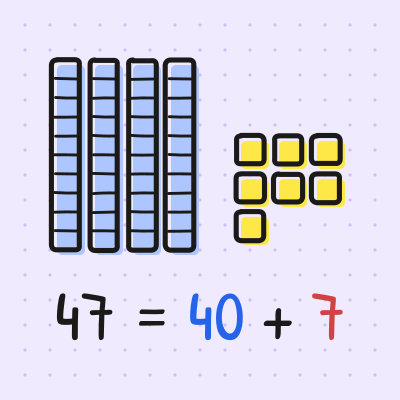
2nd grade is when math confidence takes root. Our 2nd grade math tutors ensure it doesn't crack.
Regrouping, place value, and word problems are the three skills that determine whether 3rd grade math feels manageable or overwhelming. Ruvimo tutors work specifically on these foundations. Not just drilling facts, but building the number sense that makes every subsequent math course easier. Tutors are sourced globally and go through a 3-stage vetting process including a live teaching demo.
Before the second session begins, we know exactly where your child is getting stuck. The first session identifies whether the issue is regrouping mechanics, place value notation, word problem structure, or fact fluency, because the fix is completely different depending on the answer. Most 2nd grade gaps trace to one specific breakdown, not a general struggle with math.
Word problem skills and regrouping take weeks to build, and each session has to connect to the last one. Your child works with the same tutor every session, so there is no re-explaining what was covered last week. The tutor knows which problems caused confusion, what clicked, and exactly where to pick up. That continuity is what closes gaps instead of just covering them.
Sessions follow the Grade 2 Common Core State Standards across all four domains: Operations and Algebraic Thinking, Number and Operations in Base Ten, Measurement and Data, and geometry. Whether your child's school uses Go Math, Eureka Math, or another CCSS-aligned curriculum, the tutor works from the same sequence their classroom uses, so nothing covered in sessions conflicts with what their teacher is doing.
The people who teach it
Tutors who teach 2nd grade math

Chemistry Teacher total of 8 years of experience
View profile

Turning “I Don’t Get It” into “I Get It!” Math's tutor K-11(9 yrs of Experience)
View profile

English Tutor- 5 years plus teaching English
View profile

I don’t teach math, I teach students how to THINK
View profile

KS1/KS2 English, reading and writing.
View profile

Nurturing Confidence in English, Math, and Science - 650+ students and counting - leveraging Reading & Writing Scores
View profile
After you book
How the free 2nd grade math session works
No card and nothing to decide first. If it is not right for your child, you owe nothing.
Pick a grade and a time
About a minute.
We call you
To hear what your child needs, so the tutor comes prepared.
Your child meets their tutor
45 minutes, live and 1-on-1.
- 16,000
- hours of 1-on-1 lessons taught
- 1,000+
- US students taught
- 200
- tutors on the team
- 90%
- parent satisfaction score
From other parents
What parents tell us
Four of them on video, unscripted, and more in their own words.
LeathaParent of a 6th grader“She was not reading fluently at all. Now she is reading 41 to 50 words a minute.”
JessicaParent of three“They all see the same tutor. He knows their names.”
A dadParent of a 7th grader“He was a straight-A student in sixth grade, then his grades were suffering. His grades have improved dramatically.”
MariaMom of three“They sign in by themselves. They look forward to these sessions.”
Ms. Shubhra works very well with my son. Her methods when teaching make it clear for my son to understand the lesson plan. Ms. Shubhra along with the lesson plan gives homework and goes over the homework with him. I especially love that I get a summary of how the session went and things that we as parents can work on with our child in terms of his academic plan and long-term goal.
Elementary math student's parent
I am very happy with Jude's teaching approach. He uses repetition effectively to ensure that Symphony understands the concepts and stays focused. He is calm and patient, even when she makes mistakes, which keeps the learning environment positive and encouraging. His approach has made a noticeable impact on Symphony's confidence. I would absolutely love for Jude to continue as her tutor long-term.
Elementary math student's parent
The tutor Ms. Richa made sure Tran got enough practice for her state exam. She recently got a 99th percentile in a statewide math exam. I am very happy with Ms. Richa. Her style of sending lesson notes and homework is one of the best things. I hope the English tutor sends it the same way.
Verified Parent
Pricing
Simple pricing
Your first 45-minute session is free. No credit card, no commitment. After that you buy sessions in a block and use them whenever you like.
FreeYour first 45-minute session
No credit card, no commitment.
8 sessions
$54per hour
$432 total for 8 sessions
- Valid for 3 months
- 60-minute private 1-on-1 sessions
- The same tutor every session
25 sessionsSave 17%
$45per hour
$1,125 total for 25 sessions
- Valid for 6 months
- 60-minute private 1-on-1 sessions
- The same tutor every session
- Most chosen
50 sessionsSave 33%
$36per hour
$1,800 total for 50 sessions
- Valid for 12 months
- 60-minute private 1-on-1 sessions
- The same tutor every session
- Change tutor at no charge
- Payment plans on every package
Questions parents ask
How is Ruvimo different from Khan Academy or a math app?
Khan Academy and math apps are self-paced tools. They deliver content but cannot identify why a specific child is stuck or adjust in real time. A tutor can observe that a student knows how to add but loses track of multi-step word problems because comprehension and calculation are separate skills, then shift the session to target exactly that. Apps surface incorrect answers; tutors diagnose the reasoning behind them. Ruvimo also includes parent progress summaries after each session, which no self-serve platform provides.
What do I receive after each tutoring session?
After every session, parents receive a progress summary that covers what was worked on, where the student showed confidence, and where gaps remain. Each one is written to be acted on. Not just a list of topics covered. If a tutor observes that a student's reading pace is slowing down word problem performance, or that focus improved when a parent was present, that observation appears in the summary so parents can act on it between sessions.
Can Ruvimo support honors or accelerated 2nd grade math tracks?
Yes. Tutors can work above grade level for students in accelerated programs or those ready to move ahead. This includes early introduction to multiplication concepts, more complex word problems, or place value work beyond standard 2nd grade scope. At intake, share your child's current level and any enrichment materials from school, and the tutor will calibrate accordingly. The tutor plans each session from your child's recent work, so pacing adjusts as the student advances.
Do your tutors help with homework, or only teach concepts?
Both. Tutors work through homework assignments with students and also address the underlying concepts when a pattern of errors signals a deeper gap. In practice, homework often surfaces the real issue. A student may complete addition worksheets correctly but stall on word problems because comprehension and procedure are separate skills that need separate attention. Tutors use homework as diagnostic material, not just a checklist to get through.
How quickly will my child improve in 2nd grade math?
Most parents notice a shift in confidence within three to five sessions. Measurable skill gains, such as solving two-digit addition with regrouping accurately or completing word problems independently, typically emerge within four to six weeks of consistent weekly sessions. Progress depends on the specific gap being addressed and session frequency. Students with isolated skill gaps tend to move faster than those with layered issues, such as weak computation combined with slow reading pace that increases cognitive load on word problems.
Is online 2nd grade math tutoring as effective as in-person?
For most 2nd graders, yes, with one important condition: the child needs a low-distraction environment during the session. Tutoring data from Ruvimo sessions shows that easily distracted students made measurable progress once parents rescheduled sessions to times when they could sit nearby. The online format itself was not the barrier; environment and attention management were. When those are addressed, students show the same gains in computation fluency and word problem confidence seen in face-to-face settings.
Do your tutors follow my child's school curriculum?
Yes. At intake, parents share the school's current curriculum, textbook, or unit focus, and the tutor aligns lessons to match. This matters most in 2nd grade, where schools vary in when they introduce regrouping, place value, and word problems. If your child's teacher is moving toward money math, for example, the tutor can prioritize two-digit addition with regrouping first, the foundational skill that directly unblocks coin calculation, rather than following a generic sequence.
Are Ruvimo tutors background-checked and credentialed?
Every tutor goes through AI-assisted screening followed by a manual review before being approved. Credential verification is part of the intake process. Tutors must demonstrate subject competency and teaching experience, not just hold a degree. Ruvimo tutors are based primarily in India, the Philippines, and Africa, which is how the platform keeps hourly rates accessible without reducing qualification standards. References and teaching samples are reviewed as part of onboarding.
What happens if my child doesn't connect with their tutor?
Ruvimo swaps the tutor at no charge and with no questions asked. A mismatch in personality or teaching style is normal and doesn't reflect on your child or the tutor. You can request a change after any session, and a replacement tutor is assigned before the next scheduled time. Your child's session history and progress data carry over so the new tutor isn't starting from scratch.
Will my child have the same tutor every session?
Yes. Ruvimo assigns one dedicated tutor to your child and keeps that tutor consistent across sessions. Continuity matters in 2nd grade math because tutors need time to identify the specific gap, whether it's two-digit addition with regrouping, word problem comprehension, or reading pace slowing down math performance. A rotating roster resets that diagnostic work each time. Each lesson picks up exactly where the last one left off.
How much does 2nd grade math tutoring cost at Ruvimo?
Sessions start from $36 per hour. Significantly below the $60 to $100 per hour typical of in-person or platform-matched tutors. There are no enrollment fees. A free first session is included so you can confirm the fit before committing to a schedule. The rate depends only on the package size, and it is shown before you buy.
Still have a question? Ask us and a person answers, or call +1 (254) 425-4593.
Second grade math covers three major skill areas: place value with three-digit numbers, addition and subtraction with regrouping, and foundational measurement including time and money. Students who master these by the end of Grade 2 enter 3rd grade ready for multiplication, fractions, and multi-step problem solving. A tutor identifies exactly where a student’s number sense breaks down, whether that’s regrouping, reading word problems, or understanding what the equals sign actually means, and rebuilds from that point, not from the beginning of the textbook.
Signs your child needs a 2nd grade math tutor
Most 2nd grade math gaps show up in one of three places: regrouping, word problems, or place value, and each one looks different on paper.
- Gets the right answer on isolated addition facts but writes something like 313 for 28 + 15, recording each digit column separately without understanding regrouping
- Can solve 53 − 21 easily but subtracts the smaller digit from the larger in every column when borrowing is required, writing 34 instead of 26 for 53 − 27
- Writes “two hundred five” as 2005, stacking digits as they are spoken rather than understanding positional value
- Given
5 + 7 = ___ + 2, writes 12 and cannot explain why it’s marked wrong - Knows their addition and subtraction facts cold but stalls completely on “Maria had 34 stickers, gave some away, and has 18 left, how many did she give?”
- Can count coins individually but loses track when adding coin values together, because the underlying two-digit addition with regrouping isn’t solid
What a 2nd grade math tutor helps with
A 2nd grade math tutor covers four skill clusters: place value and number sense, addition and subtraction fluency, measurement and data, and early geometry including fractions.
- Place value: hundreds, tens, and ones (2.NBT.A.1)
- Reading, writing, and comparing three-digit numbers (2.NBT.A.3, A.4)
- Addition and subtraction within 100 with regrouping (2.NBT.B.5, B.7)
- Addition and subtraction fact fluency within 20 (2.OA.B.2)
- One- and two-step word problems within 100 (2.OA.A.1)
- Telling time to the nearest five minutes (2.MD.C.7)
- Money: coins, dollar amounts, and word problems (2.MD.C.8)
- Skip-counting by 5s, 10s, and 100s up to 1,000 (2.NBT.A.2)
- Introduction to equal shares: halves, thirds, and fourths (2.G.A.3)
Students who leave 2nd grade with solid regrouping and place value skills step into 3rd grade math ready for multiplication, area, and fractions, without the computational debt that slows everything down from there.
How much does online 2nd grade math tutoring cost?
2nd grade math tutoring at Ruvimo starts from $36 per hour. No enrollment fee, and the first session is free.
- From $36 per hour. Live and 1-on-1, 60-minute sessions with the same tutor every time
- $0 enrollment fee, no setup costs or registration charges
- $0 cancellation fee. Pause or stop anytime, no notice period required
- Free first session. No credit card required to book the trial
A typical schedule of two sessions per week is about nine sessions a month, roughly $310 to $470 depending on the package, for ongoing weekly support.
For comparison, in-person learning centers generally charge more per session and often require enrollment fees or term contracts. Check Mathnasium’s site for current pricing. Private tutors sourced through marketplace platforms vary widely depending on the tutor’s location and experience. Ruvimo’s tutors are sourced globally and go through a 3-stage vetting process including a live teaching demo before joining the platform, which keeps costs lower without cutting corners on quality. If you’re weighing your options, this comparison of Mathnasium and its alternatives breaks down what parents are actually paying.
How Ruvimo compares to other 2nd grade math tutoring options
The main differences between tutoring options come down to three things: whether your child gets the same tutor every session, what you pay per hour, and whether sessions are truly 1-on-1 or shared with other students.
Ruvimo offers live, 1-on-1 online sessions from $36/hour with no enrollment fee. In-person learning centers like Mathnasium typically involve multi-student group instruction, term enrollment, and fees that go beyond the per-session rate. Visit their sites directly for current pricing. Online tutoring marketplaces connect families with a pool of tutors, so your child may work with a different person each session; rates vary widely. Ruvimo assigns one dedicated tutor matched to your child’s grade and goals, so every session builds on the last. For elementary math especially, that continuity matters.
How online 2nd grade math tutoring at Ruvimo works
Every session is live and 1-on-1, and online, with the same tutor each time. Here’s what to expect:
- Book the free session. No credit card required. Takes about a minute.
- Get matched with a dedicated tutor before the session, based on your child’s grade, the topics they’re working on, and any specific gaps you’ve noticed.
- Attend the free 45-minute 1-on-1 session, then receive a written parent progress summary by email: what was covered, what clicked, and what comes next.
Free first session. Switch tutors anytime, no charge, no questions asked.
Where 2nd grade math students lose ground
Grade 2 is the first year most students face math that cannot be solved by counting on fingers or recalling a memorized fact. The introduction of three-digit numbers and regrouping across place values demands a mental model, not just a procedure. Students who haven’t built that model pass through 2nd grade leaving behind small gaps that grow fast once multiplication and fractions arrive in 3rd grade.
Grade 2 is generally a pre-assessment year: formal standardized testing begins in Grade 3 in most states (CAASPP, STAAR, FAST, and ILEARN all begin at Grade 3). That makes the stakes feel lower, but 3rd grade benchmarks test skills that are built in 2nd grade. A gap identified now closes in far fewer sessions than one discovered after a failed 3rd grade assessment.
The curriculum covers four domains under the Common Core State Standards: Operations and Algebraic Thinking (2.OA), Number and Operations in Base Ten (2.NBT), Measurement and Data (2.MD), and geometry (2.G). The topics that generate the most downstream damage when left unresolved are regrouping, word problem structure, and place value notation. All of which sit in the first two domains.
Across all three areas, closing a specific gap typically takes 4 to 8 focused sessions once the exact breakdown is identified. The session before that identification matters most: a tutor who knows your child well can pinpoint the issue within the first 15 minutes. For students still building the foundations that lead into this grade, see 1st grade math.
Why 2nd grade math feels hard (and why it’s usually not what parents think)
2nd grade math doesn’t get harder in the way that algebra does. It gets more structural. And structure punishes gaps that drill-based practice never exposed.
The regrouping shortcut
Students who learn regrouping as a column-by-column procedure (“subtract the bottom from the top, borrow if you need to”) can pass every worksheet that presents problems in a standard vertical format. The breakdown shows up when a problem requires genuine place value reasoning rather than mechanical steps. Given 53 − 27, a student using the shortcut subtracts 3 from 7 and writes 4 in the ones column, then subtracts 2 from 5 and writes 3 in the tens. Arriving at 34. They don’t freeze. They get a confident, wrong answer. The same student writes 313 for 28 + 15, recording both digits of 13 in the ones column rather than regrouping 10 into the tens place. The error is invisible on fact-fluency drills and only appears when the procedure breaks.
Mrinnmoyee, one of our 2nd grade math tutors, recommends short daily practice sessions at home to reinforce regrouping concepts between sessions, because one session per week isn’t enough repetition for a skill that requires a new mental model, not just a new fact.
If your child gets the right answer on problems like 23 + 14 but consistently makes errors when any column sums above 9 or requires borrowing, this is almost certainly the active gap.
How to fix this:
- Use base-ten blocks or drawings, tens as rods, ones as cubes, before introducing the written algorithm. The physical regrouping has to happen before the written shorthand makes sense.
- Ask the student to explain what the “1” written above the tens column means. If they say “you carry the one,” not “you’re moving ten ones into the tens place,” the concept isn’t there yet.
- Practice with three or four problems that require regrouping every session until the explanation and the procedure match.
The equals sign means “here comes the answer”
This is one of the most well-documented misconceptions in elementary math education. Students who complete hundreds of left-to-right problems (3 + 4 = ___, 12 − 5 = ___) learn that the equals sign means “write the answer.” When the format changes to 8 + 4 = ___ + 5, they write 12. When asked why, they cannot explain the error because their internal model of the equals sign has never been challenged. It only surfaces when the blank moves to the left side of the expression or when a non-standard format appears.
In Ruvimo sessions, this pattern appears most often in students who have strong fact fluency but struggle with open equations. Exactly the students who look most ready for 3rd grade math.
If your child can answer 7 + 6 = instantly but writes an incorrect number for ___ + 5 = 13, this is almost certainly the active gap.
How to fix this:
- Replace “equals” with “is the same as” in every verbal explanation, not as jargon, but as a consistent habit until the balance model takes hold.
- Present both sides of the equation physically: “If I have 8 + 4 on this side, what do I need on this side so they’re equal?” before writing anything.
- Use a balance-scale image alongside written equations for two or three sessions until the student can explain why 8 + 4 = 7 + 5 is true without computing both sides first.
Word problems test a different skill than computation
Our tutors see this often: a student who has memorized every addition and subtraction fact to 20 can still stall completely on “Maria had 34 stickers, gave some away, and has 18 left. How many did she give away?” The computation is within reach. The obstacle is mapping the story onto a missing-addend structure. These are separate cognitive skills, and classroom instruction rarely treats them that way. Reading pace compounds it further. Students who read slowly hold a multi-step problem in working memory much longer than a fluent reader does, which increases errors even when math understanding is solid.
If your child can solve 34 − 18 on a worksheet but cannot set up that same subtraction from a two-sentence story, this is the active gap, not a computation problem, a problem-structure problem.
How to fix this:
- Before any computation, ask the student to identify what they know and what they’re looking for, and to say it out loud in their own words, not by repeating the problem.
- Practice drawing a simple bar model or number bond for each problem type (result unknown, change unknown, start unknown) until the student can match the story to the structure automatically.
- Separate the reading from the math: read the problem aloud to the student first, then ask them to solve it. If the answer improves, the gap is in reading pace, not math reasoning.
All three of these gaps are identifiable in the first session with a tutor who knows what to look for, and addressable in a handful of focused sessions, not an entire semester of re-teaching. Working with dedicated online math tutors means your child gets the same person who caught the gap building on it every week, rather than starting over.