.webp)
For a lot of families in the U.S., algebra is where things start to go sideways. Up until this point, math may have been manageable. Maybe even easy. Then algebra shows up - letters instead of numbers, long homework assignments, quizzes that suddenly feel impossible. Parents hear, “I studied, but I blanked.” Students start avoiding math altogether. That’s usually when families start searching online for help. And almost immediately, two options appear everywhere: free YouTube math videos and paid online algebra tutoring. On paper, YouTube looks like the obvious choice. It’s free. It’s fast. There are thousands of videos claiming to explain algebra “the easy way.” But after weeks or months of watching videos, many parents notice something uncomfortable: effort has increased, but results haven’t. So the real question isn’t which option exists. It’s which one actually helps students learn algebra well enough to succeed in school, on tests, and beyond.
Algebra is where math stops being concrete and starts becoming conceptual. That shift catches a lot of students off guard.
In the U.S., Algebra 1 is more than just another class on the schedule. It’s required for graduation. It’s the foundation for Geometry, Algebra 2, and higher-level math. It’s built into state exams, the SAT, and the ACT. If a student wants to go into anything STEM-related, algebra isn’t optional - it’s unavoidable.
What many parents don’t realize is that algebra introduces several new demands all at once. Students are expected to reason abstractly, track multiple steps, and apply math to word problems that don’t look like anything they’ve seen before. Even strong students can struggle here.
When a student doesn’t fully understand algebra early on, the problem rarely fixes itself. Gaps compound. Confidence drops. Math becomes something to survive instead of understand.
At that point, the way a student is learning matters just as much as what they’re learning.
YouTube didn’t become popular for math help by accident. It filled a real gap.
Students today are used to learning from videos. When they don’t understand something in class, they open a browser and search. Within seconds, they find someone explaining the exact topic they’re stuck on.
There are videos for Algebra 1 homework, Algebra 2 reviews, SAT practice problems, even AP-level previews. Many are well-produced and clearly explained. For a motivated student, that can feel empowering.
Parents often assume that exposure equals learning. If the explanation is clear enough, eventually the student will “get it.”
Sometimes that happens. Often, it doesn’t.
It’s important to be honest here. YouTube does have value.
There’s no schedule. No pressure. No waiting. A student can watch a video late at night, early in the morning, or five minutes before a quiz.
For quick reviews, that flexibility helps.
Some students really do benefit from seeing graphs move, equations unfold step by step, or word problems broken down visually. When algebra feels abstract, visuals can reduce the initial fear.
For families juggling multiple expenses, free resources matter. Not every parent is ready to commit to tutoring right away, and YouTube often feels like a reasonable place to start.
The issue isn’t that YouTube is useless. The issue is that it’s limited.
This is where expectations and reality start to diverge.
YouTube doesn’t know your child.
It doesn’t know that they missed a key concept two years ago. It doesn’t know they panic during tests. It doesn’t know they understand procedures but not why those procedures work.
Videos are made for a broad audience. Your child’s struggle is specific.
Watching math feels productive, but it’s often deceptive. Students nod along, thinking they understand, until they try the problem themselves and get stuck.
Real learning in math happens when students attempt problems, make mistakes, and are guided through correcting them. Videos can’t respond when something goes wrong.
There’s no one checking whether the student actually practiced. No one noticing when they skip the hard parts. No one adjusting the approach when frustration sets in.
From a parent’s perspective, this is especially tricky. A child may appear busy with math videos, but progress is invisible.
Not all YouTube explanations match how U.S. schools teach algebra. Different methods, shortcuts, or notation can confuse students - especially when their teacher expects a specific approach on tests.
Online algebra tutoring works because it’s built around interaction, not consumption.
A real tutor starts with questions. What does the student understand? Where do they get stuck? What’s missing?
Instruction adapts. If one explanation doesn’t work, another is tried. The pace changes based on the student, not a pre-recorded script.
Students don’t just watch - they do. They solve problems, explain their thinking, and get corrected immediately.
That back-and-forth is where understanding forms. It’s also where misconceptions are caught before they become habits.
Many students struggling with algebra aren’t lazy or unmotivated. They’re anxious.
A one-on-one tutor removes the pressure of keeping up with a classroom. Questions are encouraged. Mistakes are normal. Over time, fear gives way to confidence.
Good tutoring isn’t random help. It follows Common Core expectations, school pacing, and standardized test formats. What students practice actually matches what they’re tested on.
In practice, the difference is simple.
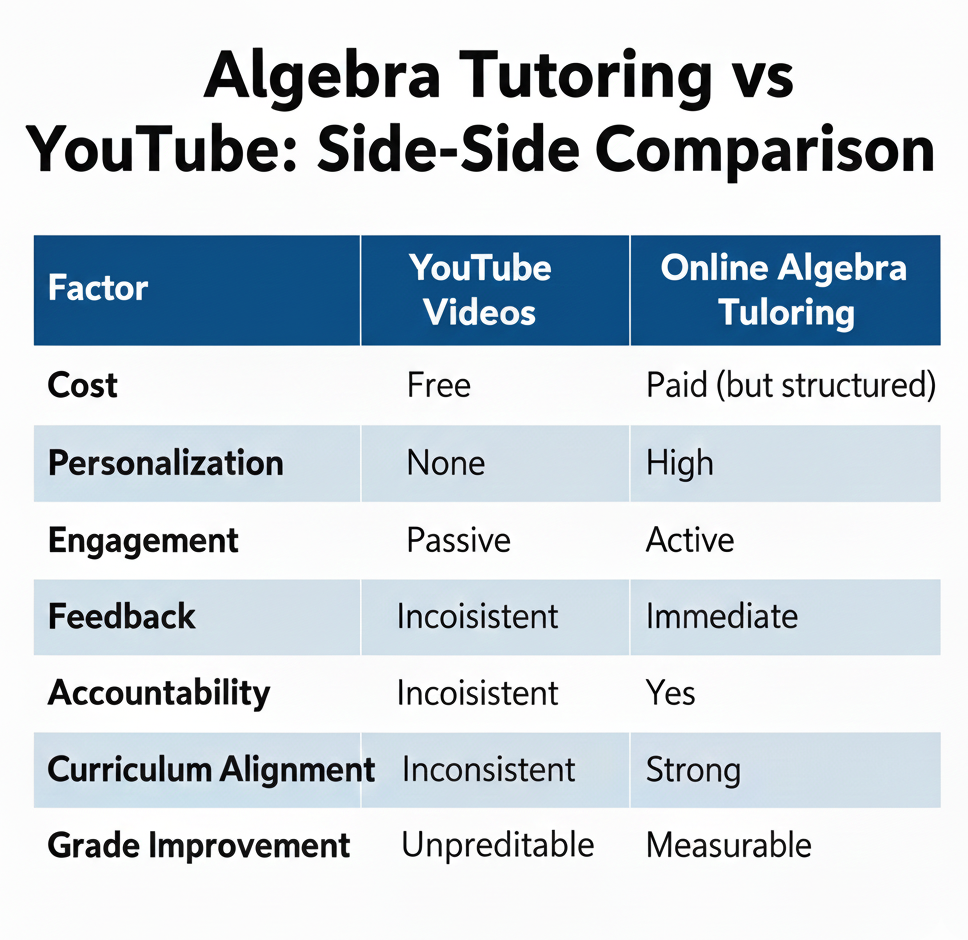
YouTube offers information. Tutoring offers instruction.
YouTube is passive. Tutoring is interactive.
When students receive consistent algebra tutoring, improvement tends to be steady and noticeable.
Grades stabilize, then rise. Test scores improve because students understand why methods work, not just how to copy them. State assessments feel less intimidating. SAT and ACT questions become familiar instead of overwhelming.
This happens because tutoring targets the root of confusion, not just the surface symptoms.
Parents often notice changes at home first.
Homework time becomes calmer. Math-related stress decreases. Teachers report better participation. Parents can finally see where progress is happening and where support is still needed.
With YouTube alone, parents are often guessing. With tutoring, they’re informed.
YouTube works best as a backup tool.
Reviewing a concept after tutoring. Getting a quick visual reminder. Reinforcing something already understood.
It’s helpful - just not sufficient on its own.
Tutoring costs money, but it saves time, stress, and long-term academic consequences.
A strong algebra foundation supports every math class that follows. It reduces anxiety. It opens doors instead of closing them.
For families thinking about college readiness, test scores, or future career paths, that investment pays off.
YouTube can show algebra.
Tutoring teaches it.
For students who need real understanding - not just explanations - online algebra tutoring is the option that consistently delivers results. When algebra becomes a barrier, the right guidance changes everything.