
This guide is for parents who want clear strategies to help their children understand fractions, decimals, and percentages—and why these skills are critical for long-term math success. If you’re looking for how to explain fractions, and help your child truly understand them as they relate to decimals and percentages, you’re in the right place. We cover not just conversion tricks, but ways to build deep, lasting fraction understanding—so your child will be ready for algebra and beyond.
What You'll Learn
Your sixth-grader confidently grabs their phone calculator when you ask: “What’s 25% off a $60 video game?” They tap away and announce: “$15 off, so $45 total.” Success.
Ten minutes later, their pre-algebra homework asks: “What is 1/4 of 60?” They stare at the page, frozen. You watch the frustration build. “We just did this,” you think. And you’re absolutely right—these are the exact same problem, just wearing different mathematical outfits.
Here’s the thing that might surprise you: This disconnect isn’t a math problem. It’s a translation problem. And it reveals something crucial about how middle school mathematics has evolved since we were students.
Research from the National Research Council shows that fraction understanding in fifth grade predicts algebra success better than any other mathematical skill—even better than whole number arithmetic. Yet here’s the catch: most of us learned fractions, decimals, and percentages as three separate topics with three sets of procedures to memorize. Your child’s curriculum takes a radically different approach, treating these as different representations within a unified rational number system. The rational number system consists of numbers that can be written as a fraction or ratio of two integers.
Fractions are made up of two integers—a numerator and a denominator. Recognizing that both parts are integers is foundational for understanding how fractions fit into the rational number system and how they relate to other number types.
The shift feels harder because it is harder—but it’s also brilliant. And understanding why might be the key to helping your child succeed without transmitting the math anxiety that 93% of American adults report feeling.
Let’s be honest about how most of us learned this: “To convert a fraction to a decimal, divide the top by the bottom.” This process is called division, where the numerator is divided by the denominator to find the decimal equivalent. “To find a percentage, move the decimal point two places.” These procedural shortcuts got us through tests, and our first instinct is to share them with our struggling kids.
Here’s the problem: Procedures without understanding are like building a house on sand. They work fine until the problems get more complex, and then everything collapses.
A Northwestern University study found something startling: math-anxious parents who frequently help with homework can actually harm their children’s learning—by over one-third of a grade level. The culprit? We teach the shortcuts that got us through, perpetuating procedural thinking rather than building conceptual understanding.
What changed since we were in school? Previous curricula treated fractions, decimals, and percentages as separate units—master the procedures for each, move on. Current standards recognize that these aren’t three different things; they’re three different ways of representing the same numbers. This is the rational number system, and fluency with it isn’t about memorizing conversions—it’s about understanding equivalence and choosing the most useful representation for any given situation.
Your role as a parent has shifted too. Instead of “Let me show you the trick,” try “What do you notice about these numbers?” Instead of swooping in with answers, create space for productive struggle. Yes, watching your child wrestle with a problem feels uncomfortable. But that discomfort is where learning happens.
The best thing you can do? Step back just enough to let them think.
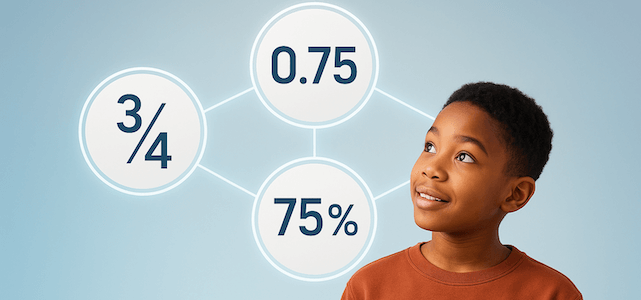
Here’s the conceptual leap that transforms everything: 0.75, 3/4, and 75% aren’t just “related.” They’re not even “equivalent.” They are literally the exact same number written in different notations. These forms are closely related and can be converted between each other.
Think of it like this: Your child is still the same person whether you call them by their full name, nickname, or “kiddo.” Similarly, three-quarters is the same mathematical quantity whether we write it in fractional form, as a decimal, or as a percentage. The rational number system simply gives us multiple ways to express the same value, and each form has situations where it shines.
For example, 0.75 is a decimal number, 3/4 is the same value in fractional form, and 75% is the percentage representation.
Let’s demolish the “just divide” shortcut and understand what’s actually happening when we write 3/4 as 0.75.
Imagine you’re adapting a cookie recipe that makes 4 batches, but you only want to make 3 batches. Every ingredient amount needs to be multiplied by 3/4. When the recipe calls for 1 cup of sugar, you need 3/4 cup. In the fraction 3/4, the horizontal line separating the 3 (numerator) and 4 (denominator) is called the fraction bar. Your measuring cup shows decimal markings: 0.25, 0.50, 0.75. That 0.75 marking is three-quarters of a cup.
But why is 3/4 equal to 0.75? The denominator tells the story. When we write 1/4, we’re saying “one piece when we split 1 into 4 equal parts.” Each of those parts is 0.25 (twenty-five hundredths). Three of those pieces? That’s 0.75 (seventy-five hundredths). Both 0.25 and 0.75 are examples of decimal fractions, where the denominator is a power of ten.
Here’s a fresh example: You and three friends split a streaming service subscription. The annual cost is $180. Each person’s share is represented by the fraction 180/4. When you divide—really divide, not just follow a procedure—you’re asking “what’s the size of each equal part when 180 is split four ways?” The answer, $45, can also be written as $45.00, which is a decimal representation of the same value.
The denominator isn’t just “the bottom number.” It tells you how many parts the whole is divided into. The numerator tells you how many of those parts you have. The decimal shows the same information using place value—tenths, hundredths, thousandths. These place values are determined by the number of digits after the decimal point.
“Percent” literally means “per hundred”—it’s not a mysterious conversion formula. When we write 75%, we’re saying “75 per 100” or “75 out of 100” or… wait for it… 75/100.
Watch the connection: 3/4 = 75% because 3/4 scaled to a denominator of 100 equals 75/100. We can scale 3/4 to 75/100 by multiplying both numerator and denominator by 25. That 75/100 is what we write as 75%.
Similarly, 0.75 = 75% because 0.75 is the decimal form of 75%, meaning “75 hundredths,” which is literally “75 per hundred.”
This matters in the real world more than you might think. Your child buys concert tickets online. Base price: $50. Service fee: 15%. They need to understand that 15% isn’t a magical calculation—it means $0.15 for every dollar of ticket price, or 15 cents per 100 cents, or 15/100 of the total, which equals 0.15 as a multiplier. So the fee is 50 × 0.15 = $7.50.
Percentages are also used to calculate percent change, such as when a ticket price increases from $40 to $50—a 25% increase—or when discounts are applied. Another important real-world use of percentages is in interest rates, which help compare how much money you earn or pay over time in financial situations.
When they understand this conceptually, they can also reason: “15% is between 10% (which would be $5) and 20% (which would be $10), so $7.50 makes sense.” This estimation skill—checking whether an answer is reasonable—is what separates students who merely compute from students who actually understand.
Here’s where it gets powerful: You don’t always need to convert everything to decimals. Sometimes fractions are cleaner. Sometimes percentages make the most sense.
Your child wants to scale that cookie recipe again—this time making two thirds (2/3) of the original amount. Working with the fraction two thirds is straightforward: multiply each ingredient by 2/3. Sometimes it's easier to multiply fractions directly rather than converting to decimals, especially when the numbers get messy. The fraction form is the right tool for this job.
But when comparing their savings account balance ($125) to their goal ($200), asking “what percentage have I saved?” makes more sense than working with the fraction 125/200. Converting to percentage (62.5%) gives them an intuitive sense of progress. Sometimes, though, you might need to add fractions or work with two fractions to solve a problem, such as when combining different savings or comparing two different scenarios.
This strategic flexibility—choosing the representation that makes the problem easiest—is the actual goal of middle school rational number work. Your child’s homework might ask them to solve the same problem three different ways not because teachers are sadistic (though I’m sure it feels that way at 9 PM), but because fluency means recognizing which representation serves you best.
Not all fractions are created equal—literally! Understanding the different types of fractions is a key step in helping your child build confidence with rational numbers and prepare for algebra.
A proper fraction is what most of us picture when we think of “part of a whole.” In a proper fraction, the numerator (the top number) is less than the denominator (the bottom number), showing that we have less than one whole. For example, 3/4 is a proper fraction: if you cut a pizza into four equal pieces and eat three, you’ve eaten 3/4 of the pizza. The value is always less than one.
An improper fraction flips the script. Here, the numerator is greater than or equal to the denominator, meaning you have one whole or more. For instance, 5/4 is an improper fraction. Imagine you have five quarters—since four quarters make a whole dollar, you actually have more than one dollar. Improper fractions often show up when adding or multiplying fractions, and they’re especially useful in calculations, even if they look a bit unusual at first.
That’s where mixed numbers come in. A mixed number combines a whole number and a proper fraction, making it easier to see how much more than one whole you have. A mixed number always represents more than one whole, combining the whole number part with the fractional part. For example, 5/4 can be rewritten as the mixed number 1 1/4—one whole plus one quarter. Mixed numbers are common in everyday life, like when a recipe calls for 2 1/2 cups of flour or you run 1 3/4 miles.
Recognizing whether a fraction is proper, improper, or a mixed number helps your child choose the right strategy for adding, subtracting, or converting between forms. It also builds a deeper understanding of how fractions represent equal parts, whole numbers, and everything in between—skills that are essential for algebra and beyond.
This feels logical, right? 8 is bigger than 4, so 1/8 should be bigger than 1/4. This misconception is so common it has a name: “whole number dominance.” Students apply whole number reasoning where it doesn’t belong.
The fix isn’t correcting them—it’s helping them visualize what denominators actually mean. Ask: “Would you rather have 1/8 of a birthday cake or 1/4?” The light bulb moment: larger denominators mean more pieces, which means smaller individual pieces. For example, if you divide a chocolate bar into six equal parts, each part is 1/6 of the whole. The denominator shows how many equal parts the whole is split into.
Try this at home: “That game is 1/8 downloaded. Mine is 1/4 downloaded. Which will finish first?” When they see that 1/4 (25%) is more progress than 1/8 (12.5%), the denominator relationship clicks. When comparing fractions, it's much easier if they have the same denominator—then you can just compare the numerators directly.
Many students freeze when asked to compare 7/8 and 2/3, waiting for the lengthy process of finding common denominators. When comparing fractions with different denominators, one method is to find a common denominator, which allows you to directly compare the values. But here’s a faster path: use benchmark numbers.
Both fractions are less than 1 (since numerators are smaller than denominators). But 7/8 is only 1/8 away from 1, while 2/3 is 1/3 away from 1. Since 1/8 is smaller than 1/3, that means 7/8 is closer to 1, therefore larger. Comparing one fraction to the other fraction using their distance from 1 helps determine which is larger.
Real context: Two stores are having sales. Store A offers 7/8 off (87.5% off), Store B offers 2/3 off (about 67% off). Which is the better deal? Your child can reason this through without calculating exact percentages.
“Of means multiply.” How many times did you memorize that phrase without knowing why? Your child’s homework wants them to understand the why.
When we write “25% of 80,” we’re asking “what is 1/4 of 80?” The word “of” in mathematics does signal multiplication, but not arbitrarily—it’s asking “what portion of this quantity?” When you multiply by a percentage or fraction, the result is a portion of the original number.
Here’s a fresh example: A family streaming plan costs $16 for 6 accounts. What percentage of the cost does each person pay?
The fraction representation: 1/6 of the cost. When multiplying 1/6 (the first fraction) by $16 (the original number), you find each person’s share. If you were multiplying two fractions, the second fraction would represent another part of the whole, and you’d multiply the numerators and denominators to get the answer. The decimal: 16 ÷ 6 = 2.67 (rounded) per person. The percentage: 1/6 ≈ 16.67% per person.
Same question, three representations. The percentage form (16.67%) immediately tells us that no one person is paying close to half (50%) or even a quarter (25%) of the cost—everyone’s share is relatively small.
Understanding this web of connections means your child can approach the problem from any angle and end up at the same answer. And just as multiplying fractions is important, students also need to know about subtracting fractions—making sure to find a common denominator before subtracting the numerators, especially when working with percentages and fractions in real-world problems.
Mathematics education research shows that students build understanding by connecting abstract concepts to concrete experiences. Use what you already have around the house.
Measuring cups become fraction explorers: “This recipe needs 0.75 cups of milk. Can you find the 3/4 cup measure? Why are they the same?” Savings account statements show decimals that represent portions of dollars. Streaming service bills divided among family members create natural fraction, decimal, and percentage problems.
Use coins to explore fractions: “If you have two quarters, what fraction of a dollar do you have? How does that compare to one half?” Or, when dividing objects or food, try: “If we cut this sandwich into six equal pieces and take three, what fraction do we have? That’s three sixths, or 3/6, which is the same as one half.”
The golden question: “Can you represent this amount in a different way?” This single prompt builds flexibility.
Fight calculator dependency with a simple rule: estimate before you compute.
Your child wants a $32 t-shirt that’s 20% off. Before touching a calculator, ask: “Should the discount be more or less than $10? Why?”
They can reason: 20% is 1/5. Since 1/10 of $32 is $3.20, and 1/5 is double that, the discount should be around $6.40. (Exact answer: 20% of 32 = 6.40.) Notice that $6.40 has two digits after the decimal point, showing the precision of the answer. When working with decimals, the last digit after the decimal point tells you the place value—here, the 0 in $6.40 is in the hundredths place.
This estimation builds number sense—the intuitive feel for whether an answer makes sense.
When test-taking season arrives, this habit catches errors. If they calculate 20% of 32 and get 64, that estimation alarm goes off: “Wait, the discount can’t be double the price.”
Your child’s method looks different from yours? That’s not just okay—that’s ideal.
They convert everything to percentages before comparing. You prefer fractions. Both work. Some students might even use a complex fraction in their solution, where the numerator or denominator is itself a fraction or mixed number. Rather than insisting on your method, ask: “Why did you choose to work with percentages? Can you see how working with fractions would also work?”
If your child uses decimal notation, you can point out that the dot represents the decimal point, which separates the whole number part from the fractional part.
This validation does two things: it respects their thinking, and it builds meta-cognitive awareness (thinking about thinking). Students who can explain why they chose a particular approach are developing genuine mathematical reasoning, not just following procedures.
Sometimes, despite your best efforts, the gaps are too wide for home support to bridge.
Watch for these red flags: consistently avoiding problems with specific representations (always converting to decimals because fractions feel impossible), inability to move between forms without a calculator, frustration that escalates beyond normal challenge, or the ability to execute procedures without explaining why they work.
These aren't signs of a "bad math brain"—they're signals that conceptual understanding has gaps. And here's what matters: rational number understanding isn't optional enrichment. It's the foundation for everything that follows.
Pre-algebra and algebra require fluid movement between representations. Solving equations with fractions, understanding slope as a rate of change, working with rational expressions—all of these collapse without solid rational number sense. A student who can only work with decimals will struggle when asked to solve 2/3x + 1/4 = 5/6. A student who doesn't understand percentages as proportional relationships will find themselves lost in coordinate geometry.
This is where professional support changes the trajectory. Expert tutors recognize where conceptual gaps exist—not just "fractions are hard" but specifically "this student doesn't understand equivalent fractions" or "percentages are disconnected from fraction understanding." One-on-one instruction builds understanding without the time pressure of keeping pace with a classroom of 25 students, each with different gaps.
Ruvimo's live learning platform connects students with tutors who specialize in building the "why" behind mathematical procedures, not just rehearsing steps. With affordable rates designed to make consistent support accessible, students can work through rational number concepts at their own pace, building durable understanding rather than temporary procedural fluency.
The goal isn't fixing tonight's homework. It's building conceptual foundations that serve your child through algebra, geometry, and beyond.
Fractions, decimals, and percentages aren't topics to master and forget. They're thinking tools your child will use for life—calculating tips, comparing loan rates, adjusting recipes, understanding statistics, interpreting scientific data. Every time they read "60% chance of rain" or evaluate "buy 2 get 1 free vs. 40% off," they're using rational number reasoning.
Your role as a parent isn't to have all the answers. It's to create an environment where curiosity matters more than performance, where struggle is normalized, and where understanding is valued over speed.
The parent paradox: Sometimes the best help is stepping back. When you resist the urge to "just show them the trick," you're giving them space to build genuine understanding. When you ask questions instead of providing answers, you're teaching them to think mathematically rather than just compute.
If you catch yourself saying "I was never good at this either," pause. Reframe: "This is challenging, and challenging work is worth doing." Your mindset matters more than you realize. Students whose parents convey that mathematical ability is developed through effort rather than fixed at birth show significantly greater persistence and achievement.
Your child is learning to think flexibly about numbers—to see the same value from multiple angles, to choose strategic representations, to reason about quantities rather than just manipulate symbols. This is mathematical power, and it extends far beyond passing pre-algebra.
These foundational rational number concepts pave the way for algebraic thinking. Understanding how to work with fractions, decimals, and percentages prepares students for variables, equations, and functions. In our complete guide for pre-algebra, we explore how these rational number skills connect directly to solving equations and understanding linear relationships—the heart of algebra itself.
The work you're doing now—building conceptual understanding rather than procedural shortcuts—pays dividends for years to come. Your child's mathematical future is being built in these seemingly simple fraction, decimal, and percentage problems. Make them count.
Jude is a compassionate Filipino educator whose unique blend of nursing expertise and tutoring experience allows him to support learners with both skill and sincerity. Since 2019, he has taught English to students of all ages and has also spent the last two years helping learners strengthen their understanding of Mathematics. He tailors each lesson to fit every student’s learning style and goals, whether they want to speak English more confidently, excel in math, or develop effective study habits. Known for his warm personality and patient guidance, Jude creates an online learning environment where students feel encouraged, motivated, and capable of achieving real progress. His mix of professional discipline and genuine care makes him a reliable mentor in every learner’s academic journey.

